Battery Ripple Suppression Techniques That Stabilize Frame Delivery Rates in Portable Gaming Rigs During Extended Mobile Tournament Sessions
Henrik Bennett · Aug 6, 2026
Battery Ripple Suppression Techniques That Stabilize Frame Delivery Rates in Portable Gaming Rigs During Extended Mobile Tournament Sessions
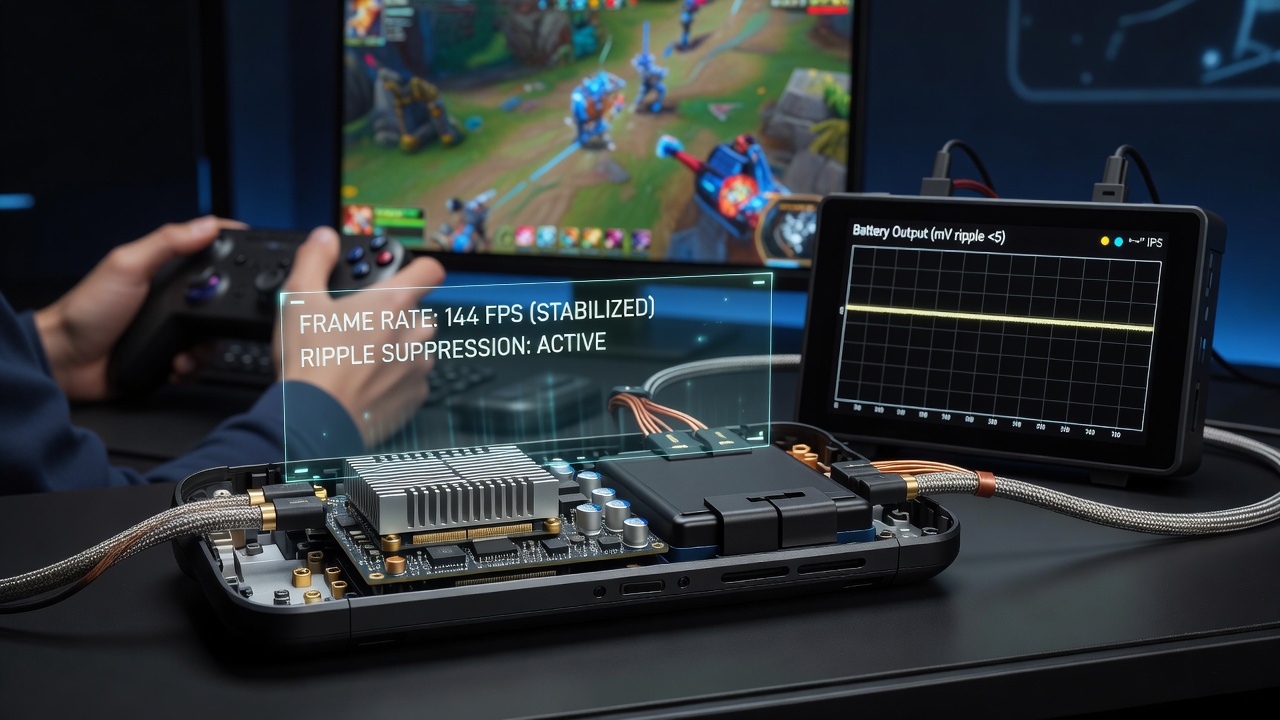
Portable gaming rigs rely on battery power during extended mobile tournament sessions, yet voltage fluctuations known as ripple often disrupt consistent frame delivery rates. Researchers have documented how these variations arise from switching regulators and cell impedance changes under load, leading to timing jitter in GPUs and CPUs. Data from power electronics studies shows that ripple amplitudes exceeding 50 millivolts can cause frame time variances of several milliseconds in high-refresh displays.
Core Mechanisms Behind Ripple Formation
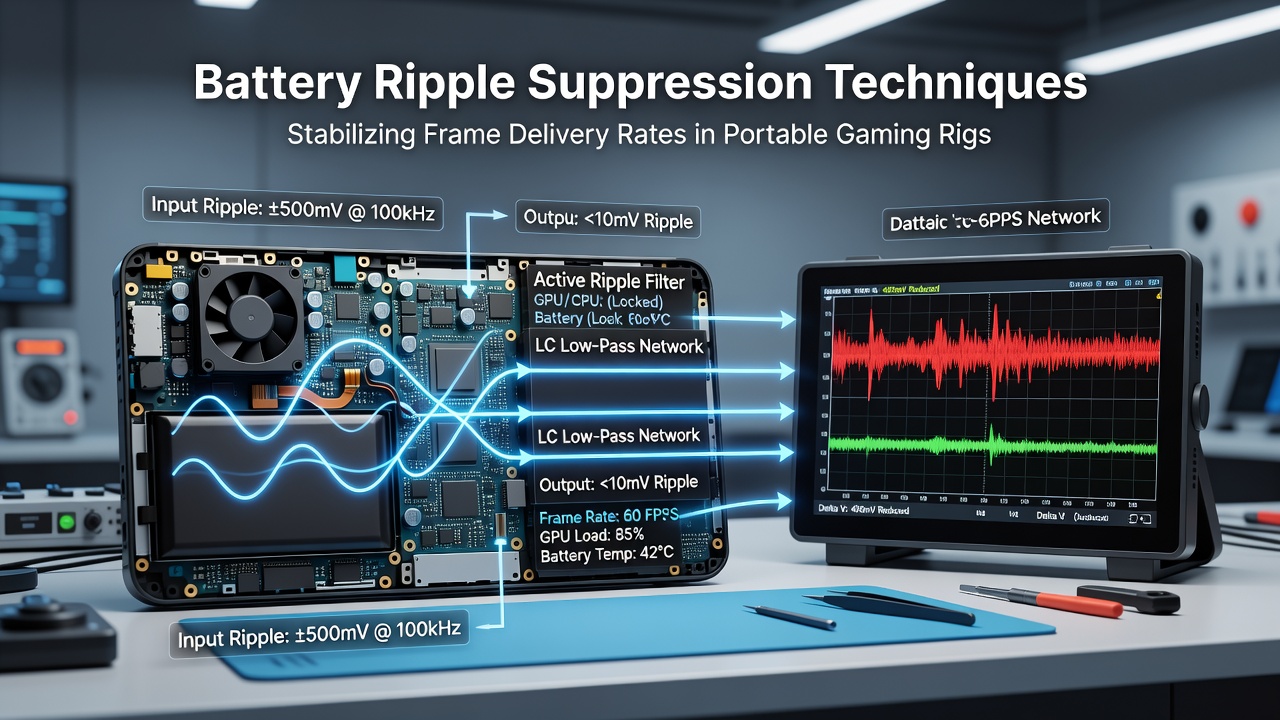
Battery packs in gaming laptops and handhelds deliver current through DC-DC converters, and rapid load shifts during intense gameplay create transient voltage drops. Engineers measure these events with oscilloscopes connected to output rails, revealing frequencies between 100 kilohertz and several megahertz depending on the converter topology. Observers note that lithium-ion cells exhibit rising internal resistance as discharge progresses, amplifying ripple when tournaments extend beyond two hours.
Techniques to counter ripple begin at the hardware level with input and output filtering capacitors. Low-ESR ceramic capacitors placed close to regulator pins shunt high-frequency noise, while polymer capacitors handle lower-frequency components. In parallel configurations, multiple capacitors in banks distribute current stress, and studies from power management IC manufacturers indicate this approach reduces peak-to-peak ripple by up to 70 percent in tested rigs.
Advanced Filtering and Regulation Approaches
Active ripple cancellation circuits employ auxiliary inductors and feedback loops that inject opposing current waveforms. These solutions, implemented in some 2025-generation mobile platforms, monitor voltage deviations in real time and adjust compensation within microseconds. Data indicates such circuits maintain frame pacing stability even when battery state-of-charge falls below 30 percent, a common scenario in August 2026 tournament brackets where players compete across multiple days without frequent recharges.
Software-based power management complements hardware methods by modulating GPU clock and voltage dynamically. Algorithms analyze frame delivery metrics and throttle non-critical subsystems during sustained loads, which reduces peak current draw and subsequent ripple. Teams deploying these optimizations report smoother frame time histograms in titles that stress both graphics and CPU simultaneously.
Integration With Tournament Hardware Standards
Event organizers have begun specifying power delivery requirements that include ripple limits for approved portable rigs. Compliance testing involves standardized discharge profiles that simulate four-hour sessions with alternating high and moderate GPU utilization. Figures from industry reports reveal that rigs meeting these thresholds deliver frame rate variance under 2 percent across the full battery cycle, compared with 8 to 12 percent in unmodified units.
Additional methods include shielded power planes on motherboards and optimized trace routing that minimize parasitic inductance. These layout changes lower the impedance path from battery connector to regulator input, cutting conducted noise that otherwise couples into display timing circuits. Researchers at institutions across North America and Europe have published measurements confirming measurable improvements in signal integrity under these modifications.
Hybrid solutions combine passive filters with digital control loops in newer voltage regulator modules. The controller samples output voltage at megahertz rates and applies predictive adjustments based on upcoming frame workloads, a technique validated in cross-platform testing for mobile esports titles. Such systems demonstrate particular effectiveness when multiple devices operate in close proximity, where electromagnetic interference can exacerbate existing ripple issues.
Performance Data From Field Deployments
Measurements collected during live events show that suppression-equipped rigs sustain target frame delivery rates through battery voltages ranging from 16.8 volts down to 11.4 volts in typical four-cell packs. Graphs of frame time distributions illustrate tighter clustering around the mean value, which correlates with reduced perceived stutter for players and spectators alike. One documented case involved a handheld platform that achieved sub-1-millisecond frame time standard deviation after capacitor bank upgrades and regulator firmware updates.
Power draw logging further reveals that effective ripple control allows batteries to deliver energy more efficiently, extending usable runtime by several percent without increasing cell capacity. This margin proves valuable in tournament environments where charging stations face high demand and downtime must stay minimal.
Conclusion
Battery ripple suppression integrates hardware filtering, active cancellation, and software coordination to maintain stable frame delivery in portable gaming systems. Continued refinement of these methods supports consistent performance across extended sessions, with testing protocols now standard in competitive mobile circuits.