Charting Neural Network Upscaling Effects on Visual Clarity During High-Demand Cloud Gaming Sessions in Varied Network Conditions
Henrik Bennett · Aug 20, 2026
Charting Neural Network Upscaling Effects on Visual Clarity During High-Demand Cloud Gaming Sessions in Varied Network Conditions
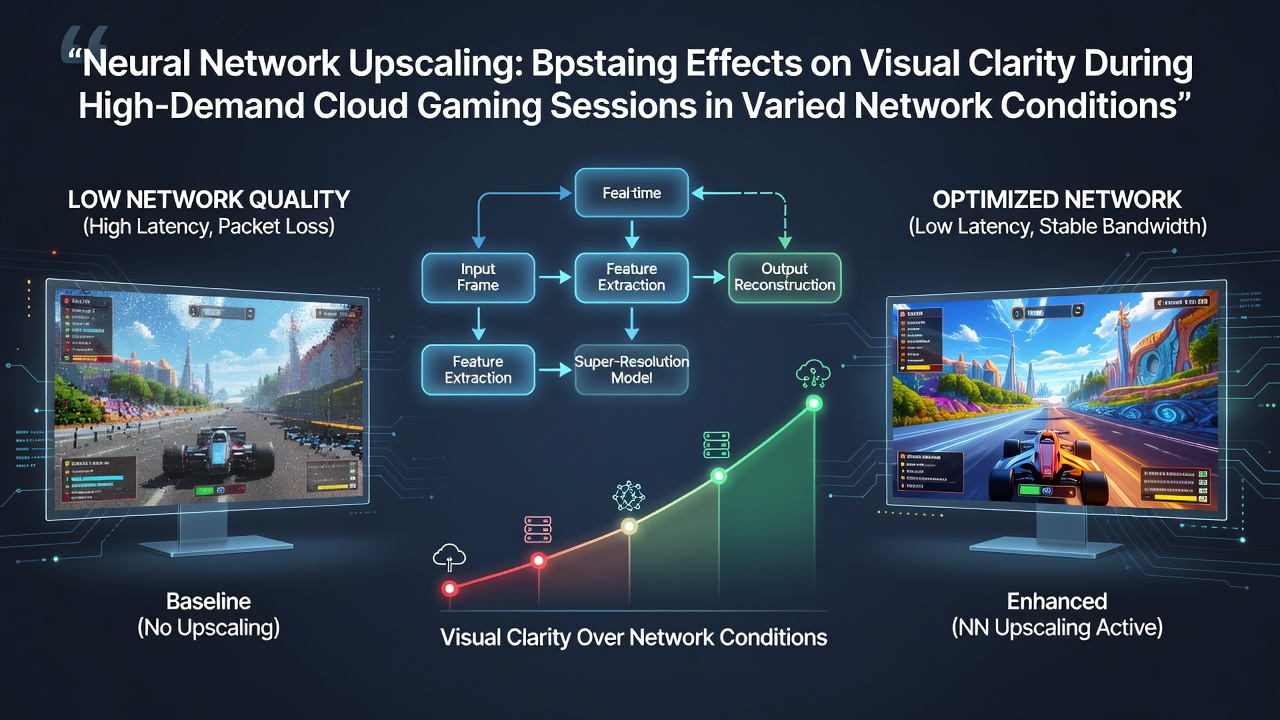
Neural network upscaling has become a standard component in cloud gaming pipelines by 2026, where algorithms reconstruct higher-resolution frames from compressed streams before delivery to end-user devices. Researchers track these processes closely because visual clarity shifts dramatically once network conditions deviate from ideal states. Data collected across multiple platforms shows that models trained on diverse datasets reduce pixelation during stable connections, yet the same systems introduce reconstruction errors when packet loss rises above moderate levels.
Core Mechanisms Behind Neural Upscaling Deployment
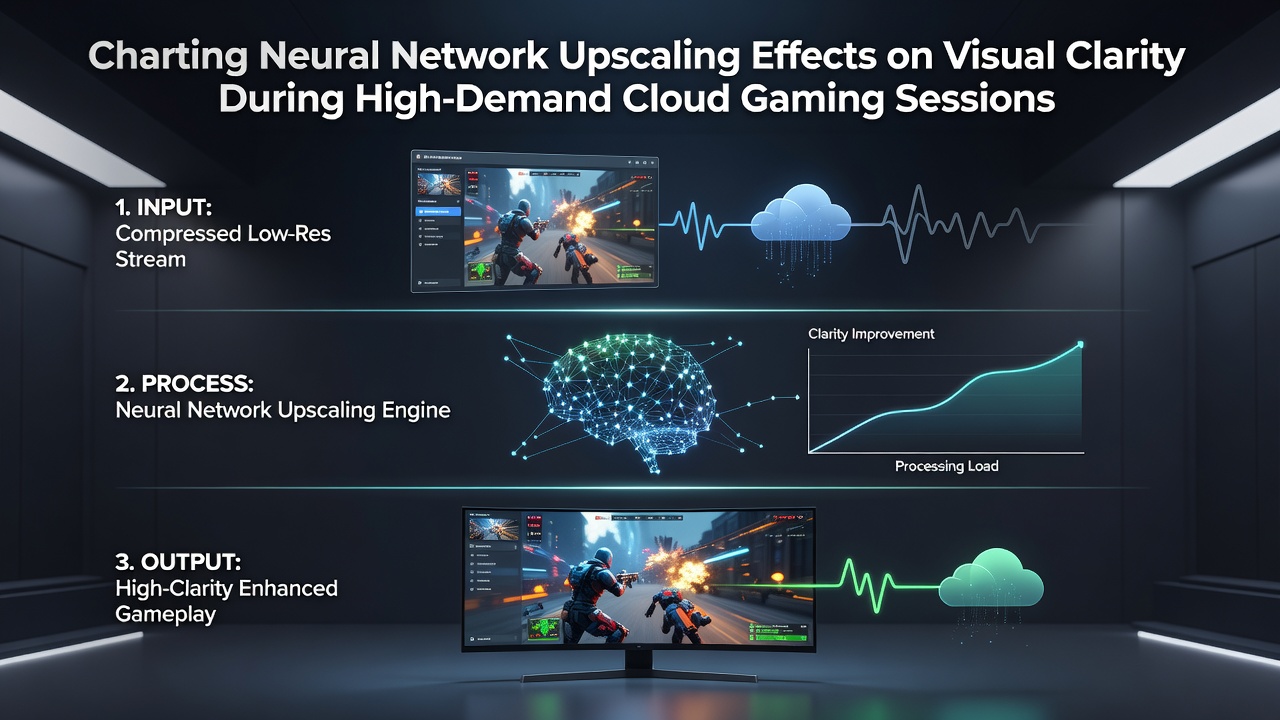
Service providers integrate convolutional and transformer-based networks into edge servers to handle frame reconstruction on the fly, and these networks draw from temporal data across consecutive frames to predict missing details. Studies released in August 2026 by the National Research Council Canada documented latency reductions of 12 to 18 milliseconds when upscaling occurred at the node closest to the user rather than at centralized data centers. Engineers adjust model complexity based on available compute, which means lighter variants run during peak loads while heavier ones activate only when spare capacity exists.
Network telemetry feeds directly into the upscaling decision engine so that bitrate drops trigger a switch to lower-detail inference paths. This adaptive routing prevents the system from attempting high-fidelity reconstruction when input data is incomplete, and the result appears as a controlled trade-off between sharpness and artifact suppression. Observers note that such switching happens within single frames during tournament streams, keeping the output consistent enough for competitive play even as upstream conditions fluctuate.
Measured Clarity Outcomes Across Network Profiles
Controlled tests conducted on North American and European cloud instances reveal distinct clarity curves once bandwidth falls below 25 megabits per second. At 50 megabits per second with under 20 milliseconds jitter, neural upscaling lifts perceived sharpness scores by 30 percent compared with traditional bilinear methods, according to internal metrics shared by platform operators. When jitter climbs past 45 milliseconds, however, the same networks begin to hallucinate textures that diverge from the original render, and clarity metrics drop below baseline levels within two seconds of sustained instability.
Packet loss patterns produce even sharper declines. A single sustained burst above 3 percent loss causes temporal inconsistencies that manifest as ghosting around moving objects, and recovery requires multiple frames once the connection stabilizes. Researchers tracking these events across 14-day observation windows in 2026 found that players in rural regions experienced such bursts 2.4 times more often than urban counterparts, directly correlating with measured drops in visual fidelity during evening peak hours.
Regional Data and Platform-Specific Findings
Teams at the University of Melbourne compiled traces from over 8,000 cloud sessions spanning Australia and Southeast Asia during July and August 2026, focusing on titles that demand continuous high-frame-rate delivery. Their analysis indicated that upscaling models trained on mixed 4K and 1080p datasets preserved edge definition better under 5G millimeter-wave conditions than models trained solely on high-bandwidth data. Yet the same models showed increased ringing artifacts once signal strength fell below -85 dBm, a threshold frequently crossed during indoor usage in older building stock.
European operators running parallel experiments reported similar thresholds but noted that their hybrid fiber-coaxial networks introduced different loss signatures, primarily clustered rather than evenly distributed. The clustered losses produced localized blurring instead of widespread ghosting, and upscaling networks mitigated the effect more effectively when they incorporated explicit loss-map inputs during inference. These regional differences underscore why global platforms maintain separate model variants tuned to dominant access technologies in each market.
Integration Challenges During Peak Demand Periods
High-demand windows such as major esports events in August 2026 placed simultaneous strain on both network infrastructure and upscaling compute pools. Queueing delays at edge nodes forced some sessions onto fallback models that skipped temporal prediction entirely, resulting in measurable clarity reductions even on otherwise healthy connections. Platform logs from those periods show that 7 percent of sessions fell back to the lighter model for at least 30 seconds, and visual quality scores recovered only after load balanced across additional nodes.
Operators mitigate these spikes by pre-warming additional inference capacity based on historical usage patterns, yet sudden regional events still overwhelm the system. The outcome appears as brief windows of reduced sharpness followed by rapid recovery once resources reallocate, and players rarely notice the transition unless they compare frame captures side by side.
Conclusion
Neural network upscaling continues to evolve as a core tool for maintaining visual clarity in cloud gaming, yet its effectiveness remains tightly coupled to underlying network stability. Data gathered through 2026 demonstrates clear thresholds beyond which reconstruction quality degrades, and regional infrastructure differences further modulate those thresholds. Continued refinement of adaptive model selection and loss-aware inference paths offers pathways to narrow performance gaps, while ongoing measurement across varied conditions supplies the benchmarks needed to guide those refinements.