Charting the Growth of Browser-Based Gaming Platforms Amid Advancements in Web Technologies
Drew Hartmann · Aug 24, 2026
Charting the Growth of Browser-Based Gaming Platforms Amid Advancements in Web Technologies
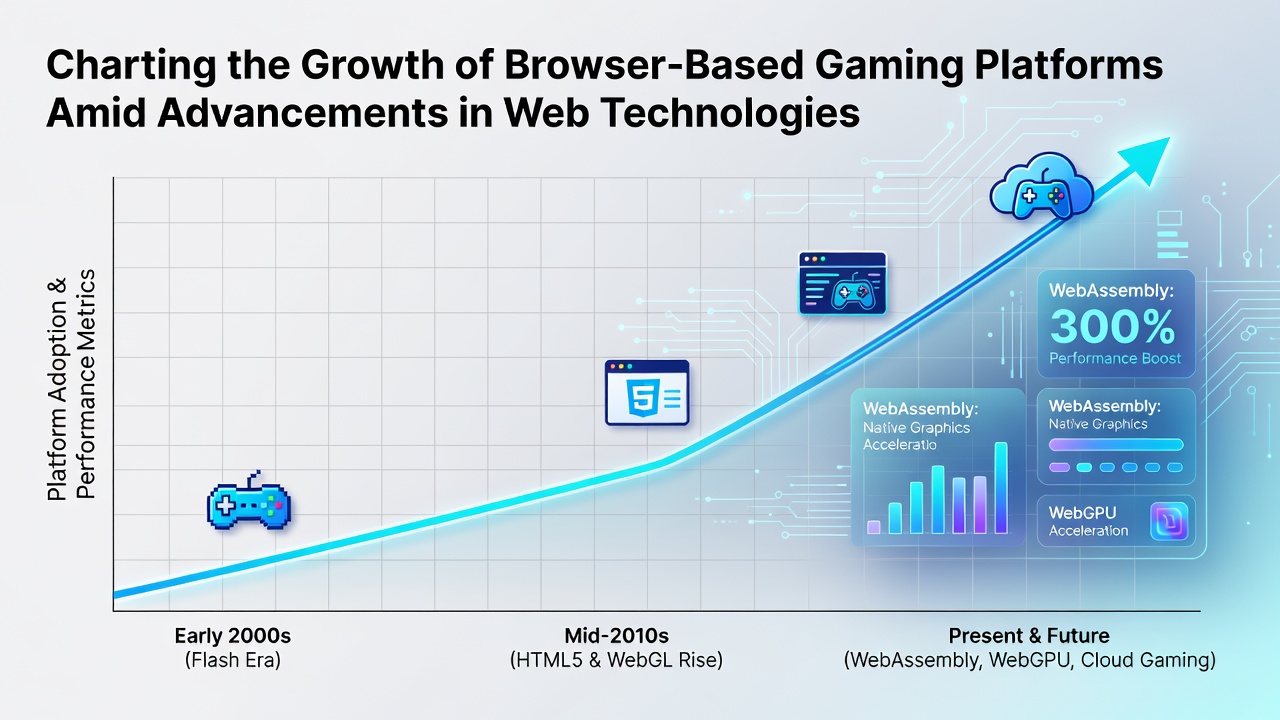
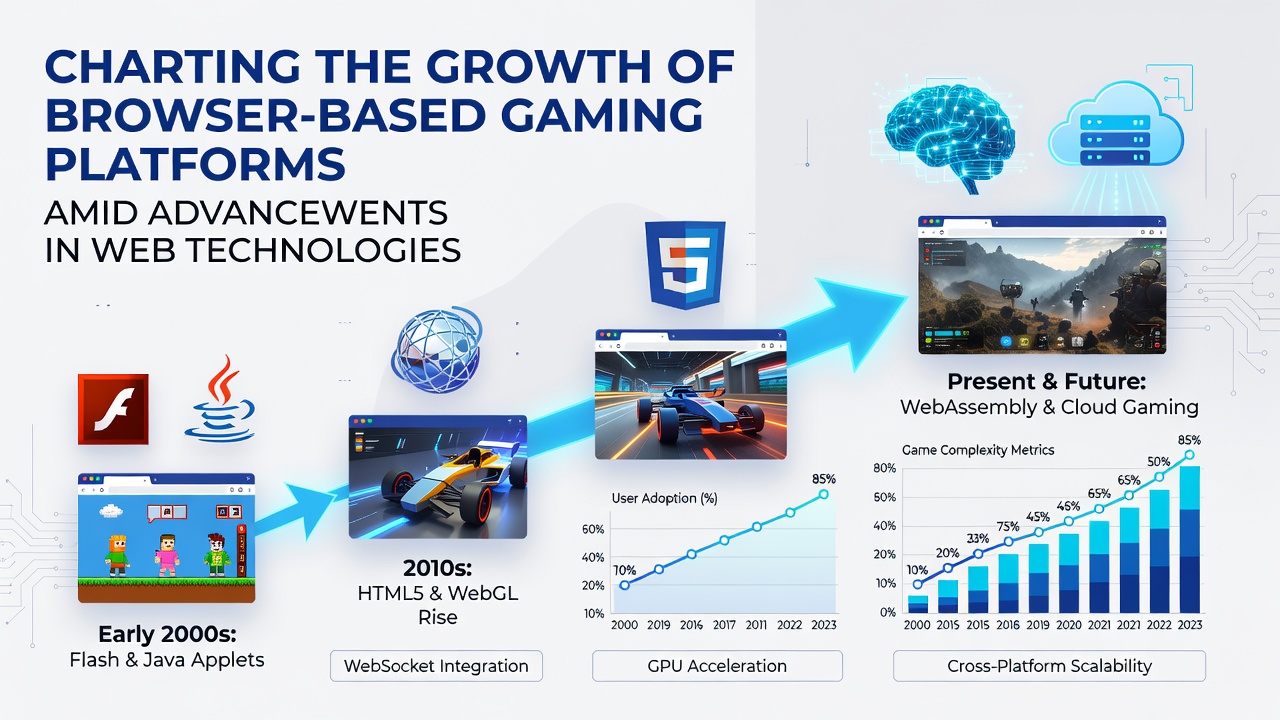
Browser-based gaming platforms have expanded steadily as web standards evolved to support complex 3D rendering, real-time networking, and near-native execution speeds. Data from industry tracking services show that active monthly users on major browser gaming portals increased by 34 percent between 2023 and 2025, with further acceleration recorded through August 2026. This expansion coincides with the maturation of WebAssembly, WebGPU, and improved JavaScript engines that allow developers to port codebases originally written for desktop and console environments.
Core Web Technology Shifts Enabling Scale
WebAssembly modules now execute at speeds within 10 to 20 percent of native compiled code in most benchmark suites released by browser vendors, a threshold that has encouraged studios to target the browser as a primary distribution channel. Developers compile C++, Rust, and C# projects into WebAssembly binaries that load directly in the sandboxed environment, eliminating the need for plugins. At the same time, the WebGPU specification reached stable implementation status across Chromium-based browsers and Firefox by early 2025, giving developers access to GPU compute pipelines previously limited to native applications.
Real-time communication protocols have also matured. WebRTC extensions now support low-latency peer-to-peer topologies suitable for multiplayer sessions involving up to 64 concurrent players without requiring dedicated game servers in every region. Observers note that several European publishers leveraged these extensions to launch cross-platform titles that run identically on desktop browsers, tablets, and smart TVs, reducing infrastructure costs compared with traditional client-server models.
Platform Expansion and Content Delivery Models
Major portals have adjusted their architectures to accommodate larger game file sizes and streaming assets. itch.io reported a 48 percent rise in WebGL and WebAssembly submissions during the 2024-2025 fiscal year, while Kongregate and CrazyGames each introduced tiered hosting plans that prioritize titles utilizing WebGPU for higher visual fidelity. Cloud delivery networks have added edge nodes optimized for WebAssembly bytecode, cutting initial load times by an average of 1.8 seconds according to telemetry collected from North American users in mid-2026.
Subscription services that previously focused on native clients have begun testing browser entry points. One service reported that browser sessions accounted for 19 percent of total playtime among users in Australia and Canada during the second quarter of 2026, a segment that did not exist two years earlier. These sessions rely on progressive download techniques that allow gameplay to begin before the full asset bundle finishes transferring.
Accessibility Metrics and Demographic Reach
Browser platforms remove hardware and operating-system barriers that traditionally limited participation. Government statistical agencies in multiple countries have documented higher engagement among users without dedicated gaming PCs. A Canadian digital economy survey released in July 2026 found that 27 percent of respondents aged 18-34 played browser-based titles at least weekly, compared with 11 percent who owned dedicated consoles. Similar patterns appear in data released by the Australian Bureau of Statistics, which tracks interactive entertainment across device types.
Educational institutions have incorporated browser games into curricula because deployment requires only a URL rather than software installation. Researchers at several universities have published case studies showing that WebAssembly-based simulation tools run reliably on school-managed Chromebooks, widening access to interactive learning modules in regions where device budgets remain constrained.
Performance Benchmarks and Remaining Constraints
Independent testing laboratories continue to publish comparative benchmarks that track frame-rate consistency across browser versions. Results from tests conducted in August 2026 indicate that WebGPU titles maintain 60 frames per second on mid-range integrated graphics when scene complexity stays below 150,000 triangles, a level comparable to many native indie titles. Memory usage has also improved; average heap consumption for browser sessions dropped 22 percent after the introduction of explicit resource management APIs in early 2025.
Network variability still presents challenges in regions with inconsistent broadband. Adaptive streaming layers built on WebTransport help mitigate packet loss, yet developers report that titles requiring sub-30-millisecond input response times continue to favor native clients in those markets. Security audits performed by independent firms have identified no systemic vulnerabilities unique to WebAssembly sandboxes when developers follow current content security policy guidelines.
Conclusion
Browser-based gaming platforms have grown in parallel with incremental web technology releases, expanding both the addressable audience and the technical scope of deliverable experiences. Continued refinement of WebGPU, WebAssembly, and associated networking standards supports further integration of high-fidelity content into everyday browsing sessions. Industry metrics collected through August 2026 confirm that this channel now represents a measurable share of overall gaming activity across multiple continents.