Circuit Board Trace Optimizations That Enhance Signal Integrity for Low-Latency Network Adapters in Online Battle Arenas
Drew Hartmann · Jun 15, 2026
Circuit Board Trace Optimizations That Enhance Signal Integrity for Low-Latency Network Adapters in Online Battle Arenas
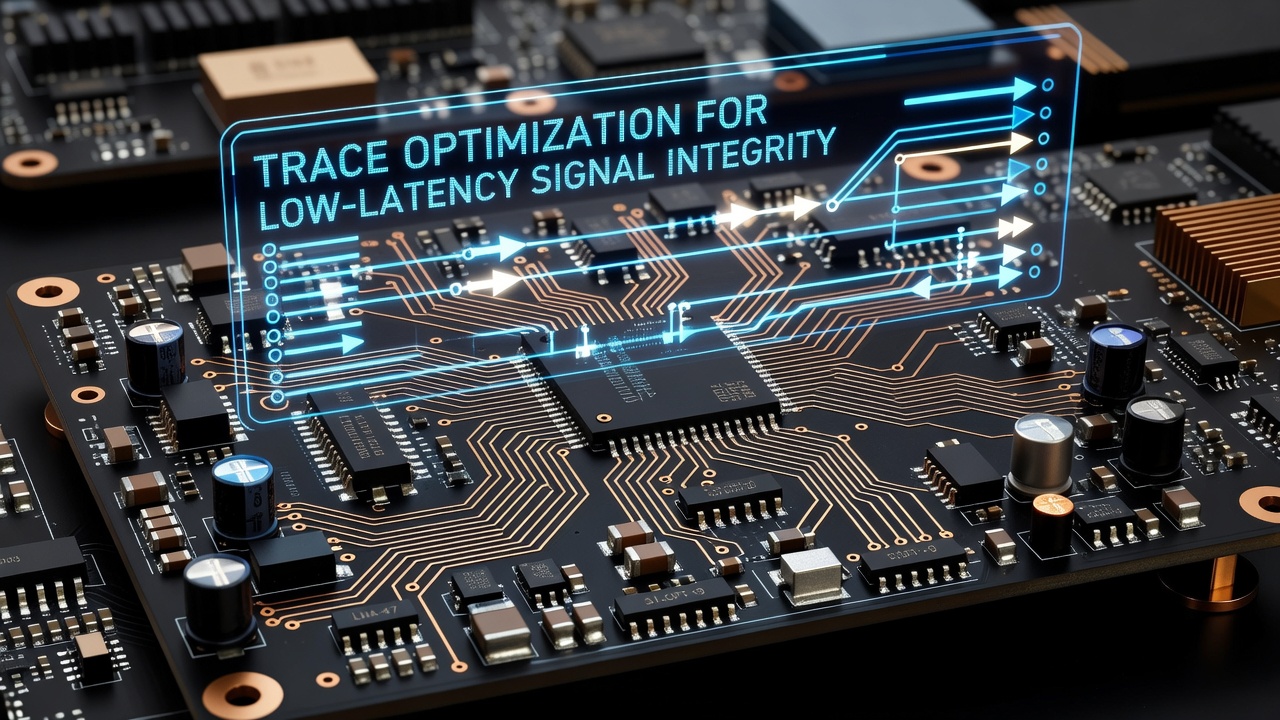
Network adapters designed for competitive online battle arenas rely on precise circuit board trace layouts to maintain clean data transmission at high speeds, and trace optimizations address issues like impedance variations, crosstalk between adjacent lines, and electromagnetic interference that can introduce jitter or packet delays during intense matches. Engineers adjust trace widths, spacings, and routing paths to match the characteristic impedance required by protocols such as PCIe or Ethernet, which reduces reflections that corrupt signals traveling between the adapter and the host system.
Core Principles of Trace Routing for Signal Integrity
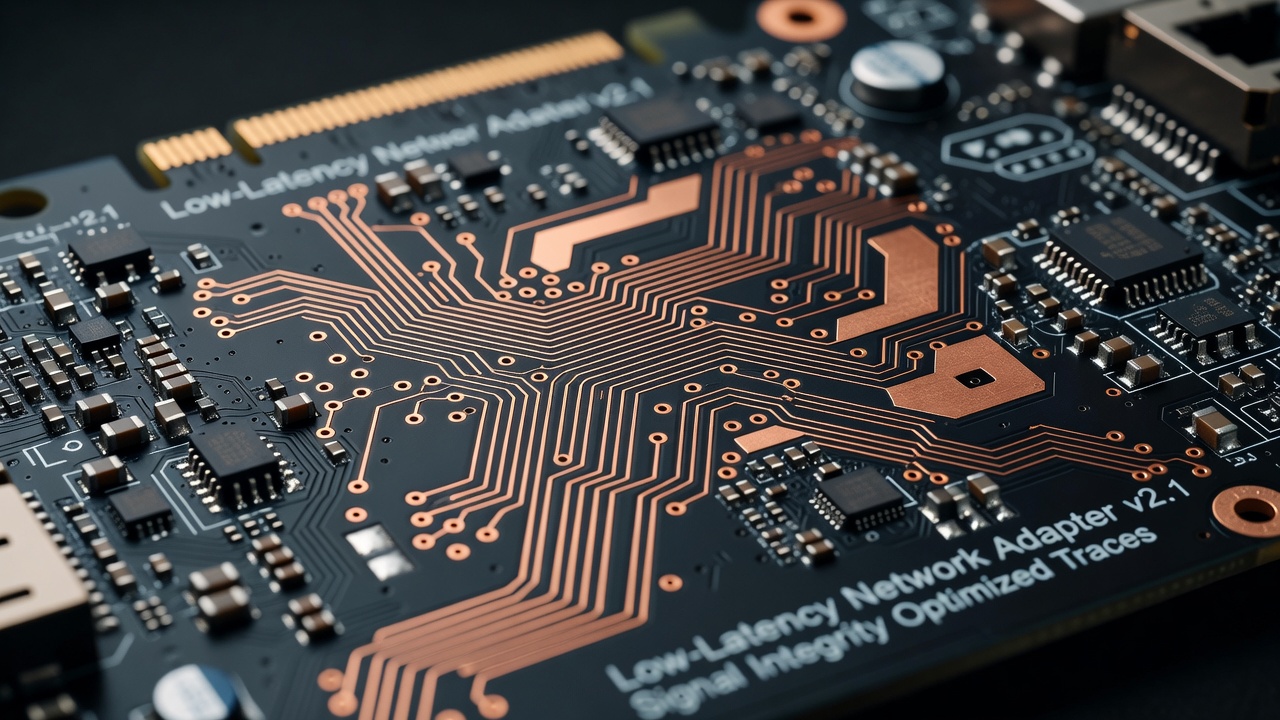
Designers calculate trace geometry using formulas that account for dielectric constants of the board substrate, copper thickness, and reference plane distances, since even small deviations alter impedance and create standing waves that degrade high-frequency components essential for low-latency performance. Differential pair routing keeps positive and negative signals close together so that common-mode noise cancels out, while length matching within picoseconds ensures timing alignment across multiple lanes in multi-gigabit interfaces. Ground planes placed directly beneath signal layers provide low-inductance return paths that contain electromagnetic fields and prevent them from coupling into nearby traces or external components.
Via placement also receives careful attention because each transition through the board introduces inductance and potential stubs that act as antennas for unwanted radiation, and back-drilling or blind vias minimize these effects in dense layouts found on compact network cards used in tournament setups. Researchers have documented how serpentine routing compensates for length mismatches without creating sharp bends that increase radiation, and simulation tools verify these patterns before fabrication to confirm eye diagrams remain open at target data rates.
Material Choices and Manufacturing Techniques
Substrate materials with lower loss tangents, such as certain FR-4 variants or specialized laminates, allow signals to propagate farther with less attenuation at frequencies above 5 GHz, which matters for adapters handling 10 GbE or faster connections in cloud-linked battle arenas. Copper surface roughness affects skin effect losses at high frequencies, so smoother foils reduce resistance and preserve signal amplitude over the length of the trace. Controlled impedance manufacturing processes use test coupons on production panels to verify that finished boards meet tolerance bands of plus or minus 10 percent, ensuring consistency across batches supplied to hardware vendors.
Performance Data from Recent Implementations
Measurements taken in June 2026 on updated network adapter designs revealed measurable reductions in jitter when trace optimizations were applied, with eye height improvements reaching several millivolts at 28 Gbps signaling rates according to reports compiled by the European Telecommunications Standards Institute. These gains translate directly into more stable frame delivery for clients connected to regional servers, where even microsecond variations can affect hit registration in fast-paced titles. Industry testing conducted by the PCI-SIG working groups has shown that proper termination and via stitching lower bit error rates below 10^-12, a threshold that keeps retransmissions negligible during extended online sessions.
Thermal considerations enter the picture as well because power dissipation along traces can create localized heating that shifts dielectric properties and alters impedance over time, prompting designers to incorporate thermal relief patterns and copper pours that distribute heat without compromising return paths. Observers note that adapters incorporating these combined electrical and thermal optimizations exhibit fewer dropouts when subjected to sustained loads typical of marathon esports events.
Integration with System-Level Latency Reduction
Low-latency network adapters feed directly into the broader ecosystem of tournament hardware, and trace integrity ensures that the physical layer does not become the bottleneck when software stacks and server tick rates already operate at sub-10-millisecond intervals. Shielding around high-speed sections further isolates traces from switching noise generated by nearby voltage regulators or memory buses, while stitching vias along board edges contain fields that might otherwise escape and interfere with wireless peripherals. Data compiled by the National Institute of Standards and Technology indicates that boards meeting these layout criteria maintain compliance with emission limits while supporting the dense pinouts required for multi-port configurations in gaming rigs.
Case examples from adapter manufacturers illustrate how iterative trace tuning reduced measured round-trip times by measurable margins in controlled lab environments, although real-world results depend on cable quality and switch hardware downstream. Those who have examined production boards from multiple vendors find consistent adoption of 45-degree or curved corners instead of 90-degree turns, a practice that cuts radiated emissions and preserves signal fidelity across temperature cycles encountered in crowded arena venues.
Conclusion
Trace optimizations form a foundational layer of hardware engineering that supports the demanding timing requirements of online battle arenas, and continued refinement of routing rules, material selections, and verification methods keeps pace with rising interface speeds. As adapter designs evolve through 2026 and beyond, these physical-layer improvements remain essential for delivering consistent packet delivery without introducing avoidable delays at the board level.