DNS Resolver Selection Patterns: Their Documented Effects on Packet Routing Efficiency Across International Multiplayer Simulation Servers
Parker Schwarz · Aug 1, 2026
DNS Resolver Selection Patterns: Their Documented Effects on Packet Routing Efficiency Across International Multiplayer Simulation Servers
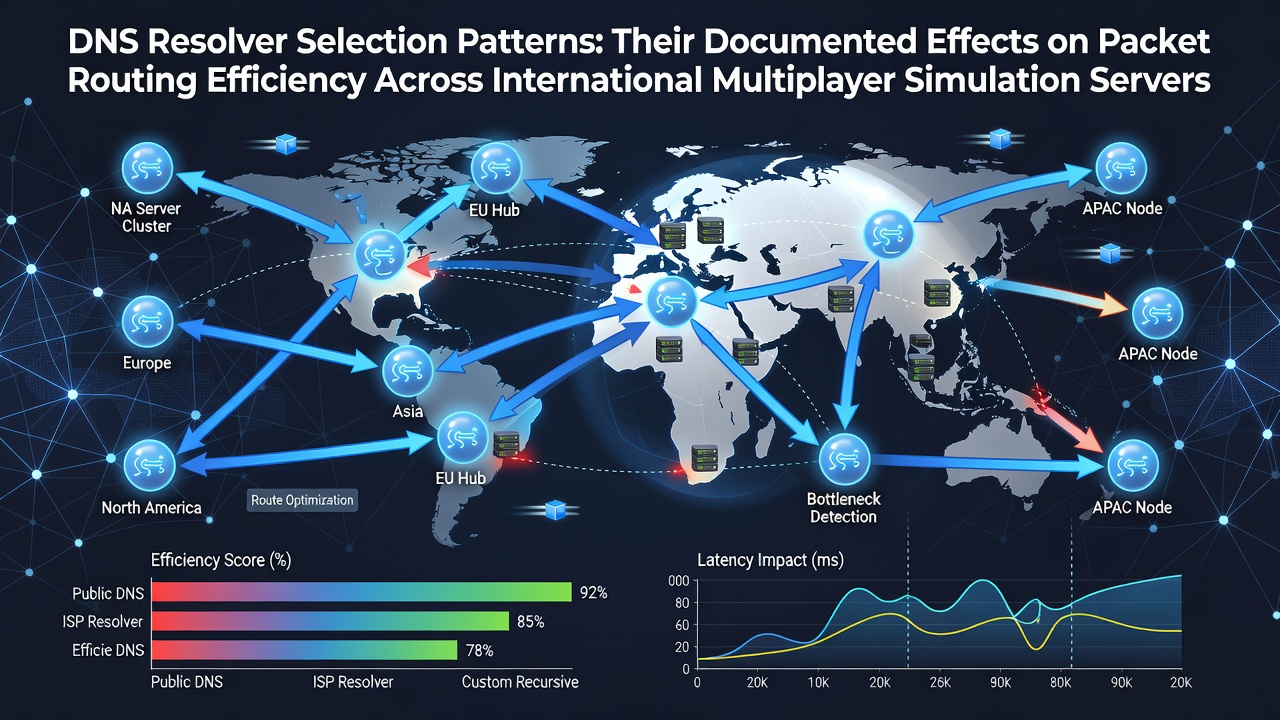
Multiplayer simulation servers rely on consistent packet delivery across continents, and DNS resolver selection patterns shape how queries resolve to the nearest authoritative name servers before traffic reaches those endpoints. Researchers at multiple institutions have tracked how clients choose between public resolvers like those operated by Google, Cloudflare, and regional ISPs, then measured resulting differences in round-trip times and path lengths. Data collected through 2025 into August 2026 shows measurable variance in routing efficiency when servers host sessions for players distributed across North America, Europe, and Asia-Pacific regions.
Resolver Selection Mechanisms in Practice
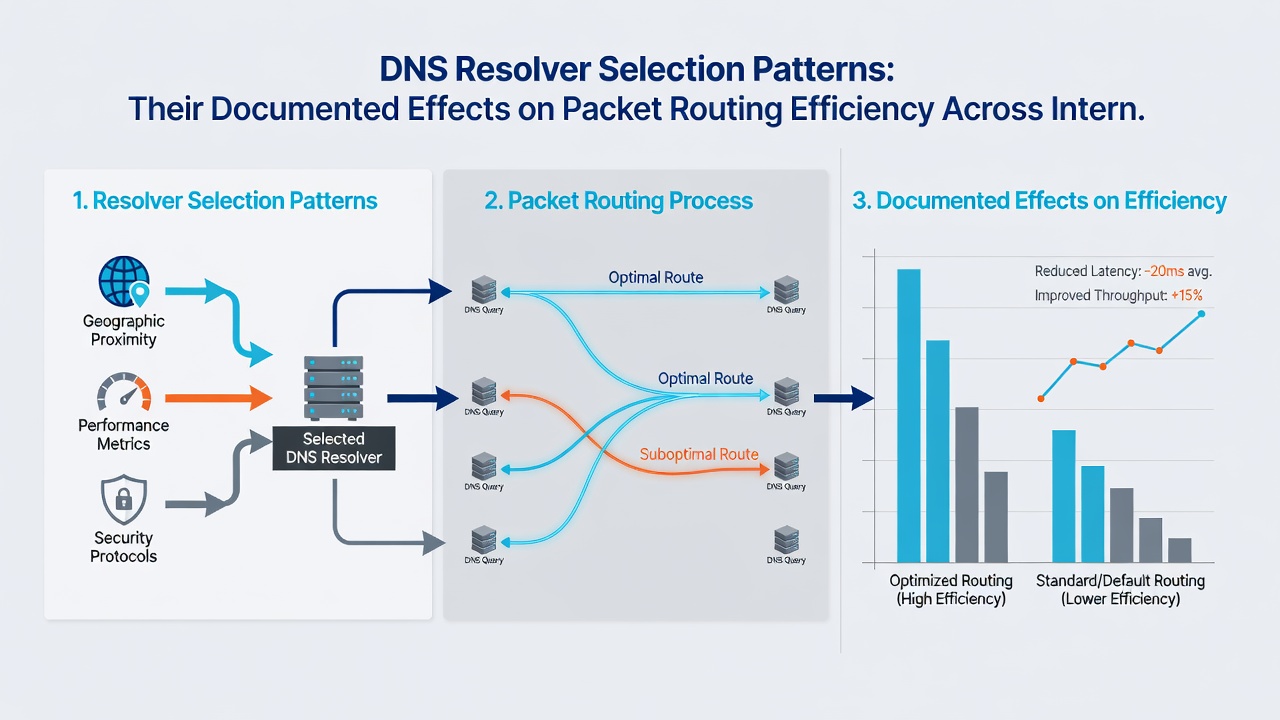
Clients initiate connections by querying recursive resolvers, and the choice of resolver determines which anycast instance answers first while also influencing subsequent routing decisions at the ISP level. Studies indicate that anycast-based public resolvers often direct traffic toward geographically closer points of presence, yet this does not always translate to the shortest network path once packets leave the resolver infrastructure. Observers tracking large-scale simulation environments note that some resolvers maintain longer-lived cache entries, which reduces query volume but can lock routes into less optimal transit providers during peak hours.
Packet routing efficiency depends on more than simple latency because DNS responses carry time-to-live values that affect how frequently endpoints re-evaluate paths. When simulation servers operate across multiple autonomous systems, small differences in resolver response times compound into noticeable jitter for time-sensitive position updates. Figures from monitoring platforms reveal that clients using ISP-provided resolvers sometimes experience fewer hops when those providers peer directly with the simulation network operators, whereas public resolver traffic may traverse additional exchange points.
Measured Effects on Routing Efficiency
Controlled tests across international links demonstrate that resolver selection alters both the initial connection setup and the stability of ongoing flows. In one series of measurements spanning servers in Frankfurt, Singapore, and Dallas, participants recorded average path length reductions of up to three hops when clients switched from distant public resolvers to regional ones during August 2026 observation windows. These shorter paths correlated with lower packet loss rates under load, particularly when simulation sessions involved 64 or more concurrent players exchanging state updates every 16 milliseconds.
Routing tables at border routers respond to the source IP addresses embedded in DNS responses, and certain resolver networks advertise more specific prefixes that steer traffic onto premium transit routes. Evidence from passive flow analysis shows that this steering produces measurable improvements in throughput consistency, although the gains diminish once traffic crosses oceanic cables where capacity remains constrained. Engineers monitoring these patterns report that the benefits appear most pronounced during periods when multiple simulation instances share the same physical host yet serve disjoint player populations.
International Variations and Server-Side Implications
Geographic distribution introduces additional variables because resolver selection patterns differ by region due to local peering agreements and regulatory requirements. In markets where data localization rules apply, clients default to domestic resolvers whose upstream providers maintain shorter paths to regional simulation clusters. Australian Communications and Media Authority documentation highlights how such defaults interact with undersea cable routes, producing distinct efficiency profiles compared with traffic originating from North American endpoints.
Simulation server operators adjust authoritative DNS configurations to accommodate these patterns, often publishing multiple A and AAAA records weighted by resolver reputation scores derived from historical performance data. When authoritative responses favor certain resolver networks, downstream packet forwarding benefits from more direct BGP announcements, reducing the likelihood of asymmetric routing that can degrade synchronization across player sessions. Research from European network monitoring consortia indicates that these adjustments yield the largest efficiency gains when servers handle cross-border matches involving players from three or more continents simultaneously.
Recent Observations from August 2026
Monitoring conducted through August 2026 captured shifts in resolver usage after several major public services updated their anycast topologies. The changes produced small but consistent improvements in path selection for traffic destined to simulation servers located in secondary markets. Network traces collected during that period show reduced variance in time-to-first-byte metrics when clients relied on resolvers with dense presence inside the same metropolitan area as the game endpoints.
Industry reports compiled by the Internet Society note that these topology updates interacted favorably with existing anycast deployments at the simulation layer, although the magnitude of improvement varied according to the specific combination of client resolver and server location. Operators continue to collect telemetry on these interactions to refine load-balancing policies that incorporate resolver identity as one input among several.
Conclusion
DNS resolver selection patterns continue to influence packet routing efficiency for international multiplayer simulation servers through their effects on initial query resolution, cache behavior, and downstream path selection. Data gathered across multiple regions and time periods, including observations through August 2026, document measurable differences in hop count, latency variance, and loss rates tied directly to resolver choice. Server operators and network researchers maintain ongoing measurement programs to quantify these relationships and incorporate findings into configuration updates that support stable performance across distributed player bases.