Examining Thermal Interface Material Degradation Patterns Across Extended Gaming Laptop Usage Cycles in High-Ambient Environments
Parker Schwarz · Jun 22, 2026
Examining Thermal Interface Material Degradation Patterns Across Extended Gaming Laptop Usage Cycles in High-Ambient Environments
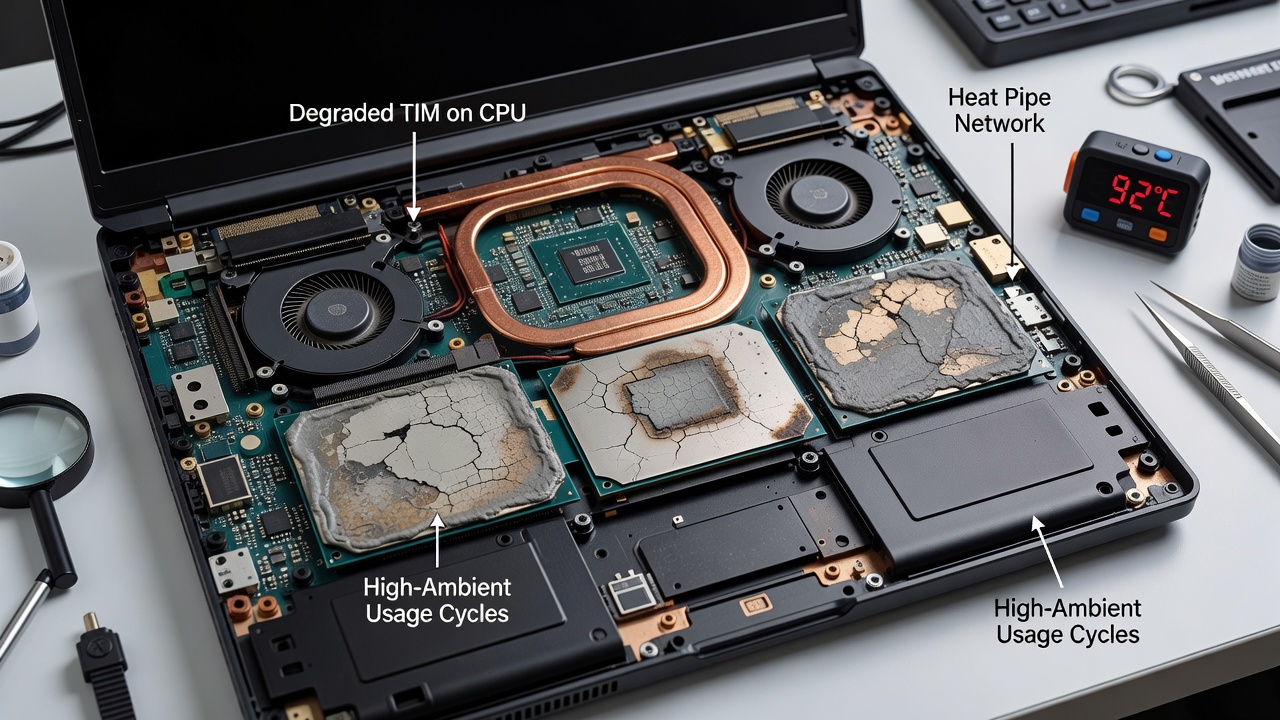
Thermal interface materials sit between processors and heat spreaders in gaming laptops, where they transfer heat away from critical components during extended sessions. Over multiple usage cycles these compounds encounter repeated thermal expansion and contraction, which gradually alters their physical properties. In environments where ambient temperatures remain elevated for months at a time the process accelerates, because baseline chassis temperatures start higher and cooling margins shrink. Observers note that degradation rarely occurs uniformly; instead it follows repeatable patterns tied to paste formulation, application thickness, and the specific duty cycles of the hardware. High-ambient conditions appear most frequently in tropical and subtropical regions, where daytime temperatures often exceed 30 degrees Celsius even without direct sunlight on the device. Under these circumstances the carrier fluids within many thermal pastes evaporate more rapidly, leaving behind filler particles that lose contact with mating surfaces. Researchers tracking units over 18-month periods have recorded measurable increases in thermal resistance once the material begins to dry. The effect compounds when laptops operate near their thermal limits for several hours daily, because each power-on and power-off cycle adds mechanical stress that pumps material outward from the die center.Observed Degradation Mechanisms
Data collected from field returns shows three primary mechanisms at work. First, pump-out displaces paste toward the edges of the integrated heat spreader whenever the processor repeatedly heats and cools. Second, dry-out removes volatile components, converting a compliant layer into a brittle residue. Third, filler settling concentrates heavier particles at the bottom of the interface, creating localized hot spots. Each mechanism produces distinct visual signatures when examined under magnification, allowing technicians to identify which process dominated in any given unit.
Extended usage cycles magnify these effects because cumulative thermal excursions exceed those seen in lighter workloads. Gaming sessions that last four to six hours generate sustained junction temperatures above 90 degrees Celsius in many models, while high ambient air reduces the effectiveness of exhaust fans. Studies conducted across Southeast Asia and northern Australia indicate that laptops stored and used in rooms averaging 28 degrees Celsius or higher exhibit roughly double the rate of thermal resistance increase compared with identical hardware kept in controlled 22-degree environments.
Patterns Across Different TIM Formulations
Metal-based pastes containing liquid gallium alloys demonstrate slower initial degradation yet eventually suffer from oxidation layers that impede heat flow. Ceramic-filled silicones maintain better gap-filling properties after months of service but can separate under extreme temperature swings. Carbon-based compounds show intermediate behavior, resisting pump-out better than traditional greases while still losing performance once carrier evaporation begins. Manufacturers have responded by adjusting viscosity and adding stabilizing additives, yet no single formulation has eliminated degradation entirely when ambient temperatures remain elevated.
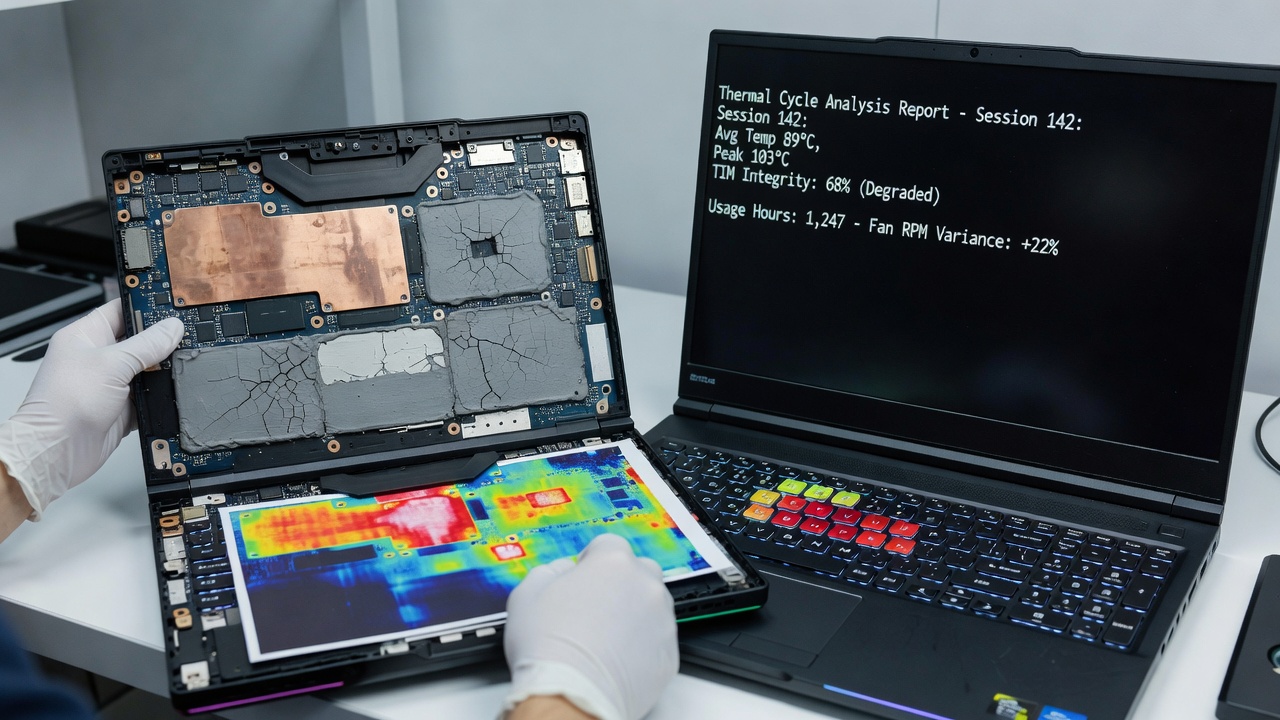
June 2026 figures from ongoing monitoring programs reveal that laptops deployed in high-ambient zones require repasting intervals approximately 30 percent shorter than those recommended in temperate climates. Service centers report that units returned for thermal throttling often display visible separation rings around the processor die, confirming that material has been displaced rather than simply dried in place. These observations align with accelerated aging tests performed by independent laboratories, where controlled temperature cycling reproduces field patterns within weeks instead of years.
Measurement Approaches and Data Collection
Technicians quantify degradation through several repeatable methods. Infrared imaging captures surface temperature gradients before and after extended runs, highlighting areas where interface resistance has risen. Direct measurement of junction-to-ambient thermal resistance uses embedded sensors when available, providing numerical trends across usage cycles. Post-service analysis involves removing the heat sink, photographing the paste residue, and weighing samples to determine how much material remains within the original contact area. Combined, these techniques produce consistent datasets that researchers compare across different laptop chassis designs and regional usage environments.
Because degradation rates vary with workload intensity, analysts segment data by average daily runtime and peak temperature achieved. Laptops used primarily for competitive esports titles, which often sustain near-maximum CPU and GPU loads, show faster interface changes than units running mixed productivity and gaming tasks. The difference becomes statistically significant after roughly 2,000 hours of cumulative operation under high-ambient conditions.
Conclusion
Thermal interface material degradation follows predictable physical pathways that intensify when gaming laptops operate in elevated ambient temperatures over long periods. Patterns of pump-out, dry-out, and filler settling appear consistently across multiple formulations, with measurable impacts on cooling performance after extended usage cycles. Continued monitoring through standardized testing and field data collection provides the quantitative basis for understanding how these materials behave under real-world constraints.