Exploring Signal Integrity Challenges in Undersea Cable Networks Supporting Global Multiplayer Tournament Synchronization
Parker Schwarz · Aug 15, 2026
Exploring Signal Integrity Challenges in Undersea Cable Networks Supporting Global Multiplayer Tournament Synchronization
Undersea cable networks form the backbone of international data transfer, carrying the bulk of traffic that enables synchronized multiplayer tournaments across continents, and researchers continue to examine how signal integrity issues arise in these long-haul fiber systems during high-stakes events. In August 2026 several major esports circuits relied on these routes for real-time match coordination between North American, European, and Asian teams, with organizers noting precise timing requirements that push the limits of current optical infrastructure.
Signal integrity refers to the preservation of data pulses as they travel through optical fibers submerged in seawater, where factors such as chromatic dispersion, polarization mode dispersion, and nonlinear effects can distort waveforms over thousands of kilometers. Data from submarine cable operators shows that even minor degradation leads to increased bit error rates, which in turn introduce jitter and packet loss that disrupt server-client synchronization in competitive titles. Observers note that tournament platforms demand sub-50-millisecond round-trip times, making any deviation in signal quality immediately visible as desynchronized actions or rubber-banding.
Physical and Environmental Factors Affecting Transmission
Seawater temperature gradients and pressure changes along cable routes create micro-bends and stress points that alter light propagation characteristics, while marine seismic activity occasionally shifts cable positions enough to induce additional attenuation. Studies conducted by research institutions in Canada and Australia indicate that seasonal variations in ocean currents correlate with measurable fluctuations in optical signal-to-noise ratios, particularly on trans-Pacific segments that support frequent cross-regional matches. Engineers monitor these parameters through embedded sensors, yet sudden events like underwater landslides still require rerouting traffic onto backup paths that may carry higher baseline latency.
Amplification stations spaced at regular intervals along the cable regenerate weakened signals, yet the cumulative noise figure of these repeaters adds to overall impairment when traffic volumes spike during global events. Figures from the International Telecommunication Union reveal that peak usage periods in 2025 already approached 80 percent of designed capacity on several major routes, leaving limited headroom for the bursty traffic patterns typical of tournament synchronization packets.
Impact on Tournament Synchronization Protocols
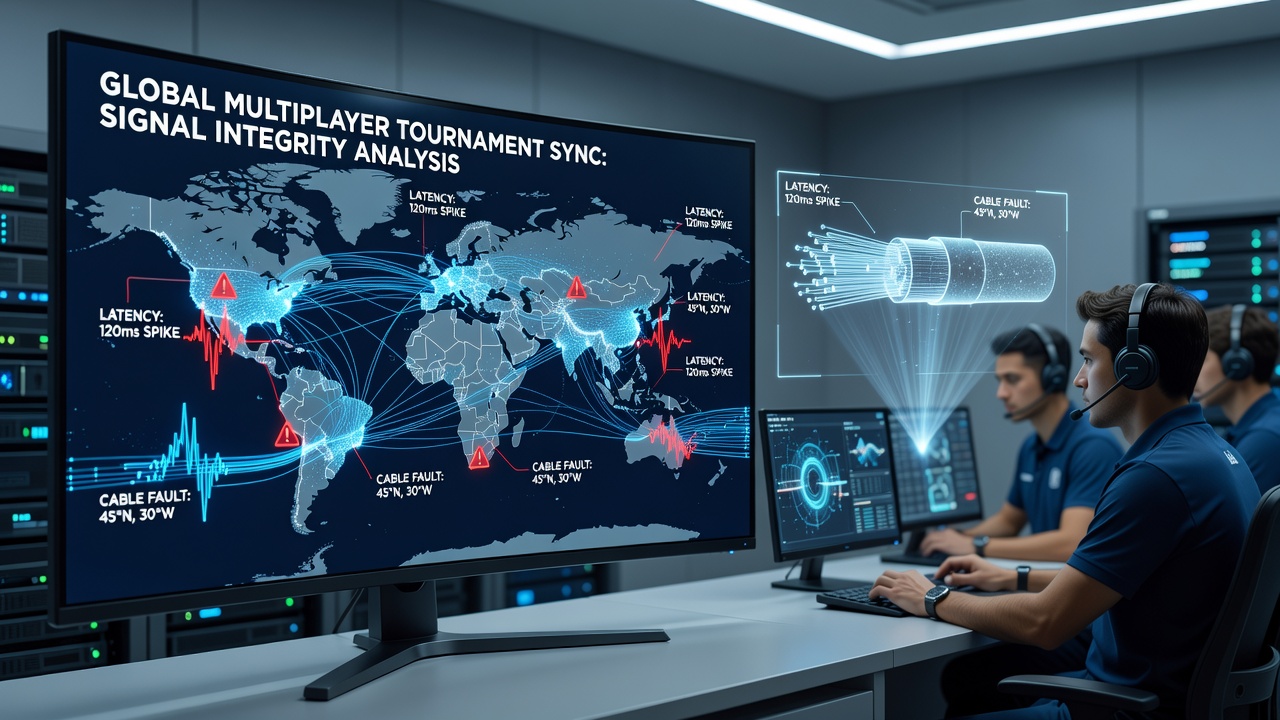
Multiplayer engines rely on deterministic lockstep or rollback netcode to maintain identical game states across participants, and any inconsistency in packet arrival times directly affects fairness. When signal integrity drops, forward error correction mechanisms activate to recover corrupted frames, yet the added processing delay compounds the problem for time-sensitive inputs such as aiming corrections or ability activations. One documented case from a 2025 championship series showed that a brief degradation event on an Atlantic cable route produced measurable desynchronization windows exceeding 120 milliseconds, prompting organizers to implement dynamic server handoff procedures.
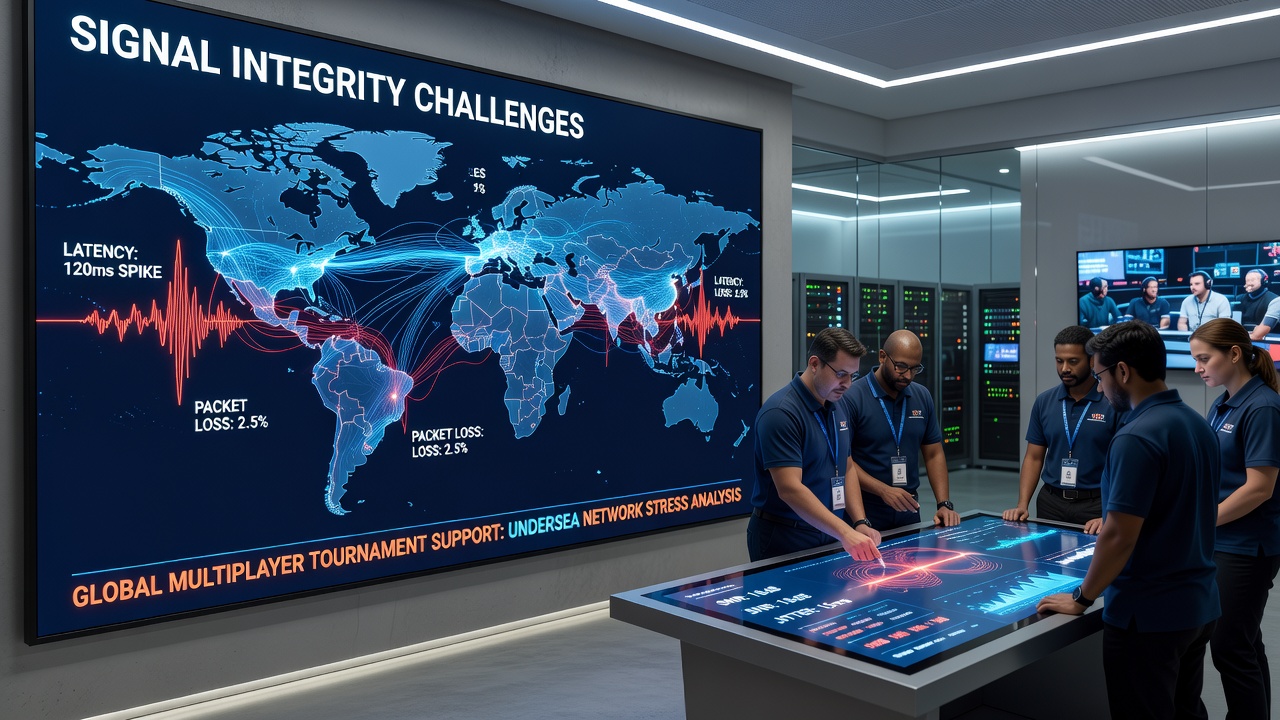
Network operators have responded by deploying coherent optical transceivers capable of real-time dispersion compensation and adaptive modulation, which adjust constellation sizes based on instantaneous channel conditions. Research published by European academic consortia demonstrates that these transceivers reduce effective jitter by up to 35 percent on routes exceeding 6,000 kilometers compared with legacy intensity-modulation formats. Tournament infrastructure teams now integrate telemetry feeds from cable landing stations to predict and preemptively shift match routing away from segments showing elevated error floors.
Mitigation Strategies and Ongoing Developments
Redundant cable systems provide alternate paths, yet load balancing across multiple routes introduces its own synchronization overhead because different fiber spans exhibit distinct propagation delays. Industry groups such as the SubOptic Association have compiled datasets showing that careful selection of primary and secondary routes, combined with software-defined networking overlays, keeps differential latency below thresholds that affect competitive integrity. In August 2026 several providers tested machine-learning models trained on historical performance logs to forecast degradation events hours in advance, allowing preemptive traffic steering before matches began.
Additional techniques include Raman amplification distributed along the fiber span and advanced digital signal processing at the receiver that compensates for nonlinear impairments accumulated over distance. Data collected by North American regulatory monitoring programs indicates these methods have lowered outage durations related to signal integrity by approximately 22 percent year-over-year on monitored transoceanic links. Continued investment in new cable systems with higher fiber counts and improved shielding aims to increase both capacity and resilience for the growing demands of distributed esports platforms.
Conclusion
Undersea cable networks remain essential for the global reach of synchronized multiplayer tournaments, yet signal integrity challenges continue to require coordinated monitoring, adaptive technology, and strategic routing decisions. Ongoing measurements from operators and research bodies document both the scale of these impairments and the effectiveness of current mitigation approaches, providing a factual basis for planning future infrastructure that supports expanding international competition schedules.