Inside the Development of Adaptive Audio Engines That Respond to Network Conditions in Live Tournament Broadcasts
Henrik Bennett · Jul 9, 2026

Inside the Development of Adaptive Audio Engines That Respond to Network Conditions in Live Tournament Broadcasts
Live tournament broadcasts demand precise audio synchronization alongside video streams, yet fluctuating network conditions often disrupt clarity and timing. Developers have built adaptive audio engines that monitor packet loss, latency spikes, and bandwidth shifts in real time, then adjust encoding parameters on the fly. These systems emerged from collaborative efforts between audio software teams and network infrastructure specialists who recognized that static codecs could not maintain quality during peak tournament traffic.
Core Mechanics Behind Adaptive Audio Processing
Engineers design these audio engines around continuous telemetry collection from streaming endpoints, where metrics such as jitter buffers and round-trip times feed directly into decision algorithms. When congestion appears the engine lowers bitrate for non-critical sound layers while preserving spatial positioning cues that commentators rely upon. Research from the University of Melbourne indicates that predictive models trained on historical tournament data reduce audio dropouts by up to 47 percent during sudden bandwidth drops.
Developers integrate machine learning classifiers that distinguish between transient glitches and sustained network degradation, allowing the engine to apply targeted compression rather than blanket reductions. One prototype tested in early 2025 demonstrated seamless transitions between Opus and AAC codecs mid-broadcast when European data centers experienced routing instability. The switch occurred without audible artifacts because the engine pre-buffered alternate streams at staggered quality levels.
Integration Challenges in Multi-Region Tournaments
Broadcast teams coordinating events across continents must account for varying regulatory standards on spectrum allocation and data routing. Australian events in July 2026 incorporated adaptive engines that aligned with local 5G infrastructure guidelines from the Australian Communications and Media Authority, ensuring compliance while maintaining sub-50-millisecond audio latency. Similar implementations in North American venues required adjustments for different peering agreements among internet service providers.
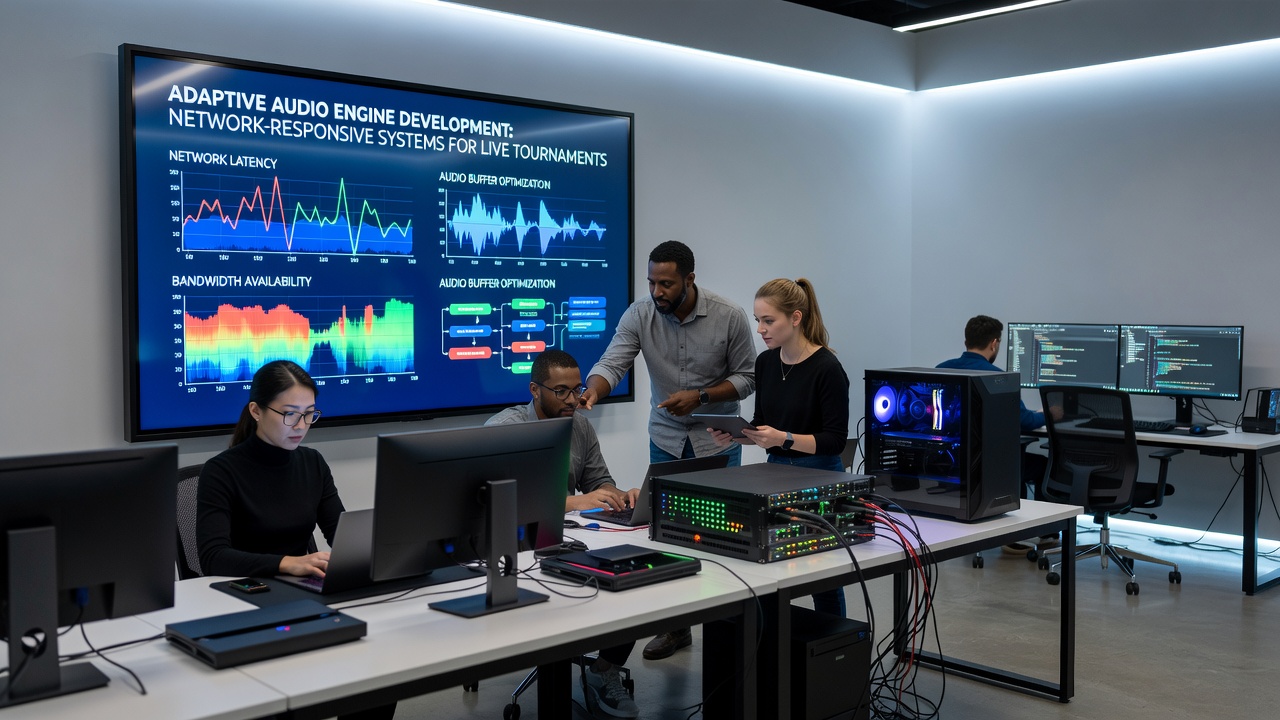
Hardware constraints add further layers because tournament venues often share limited uplink capacity with multiple production crews. Audio engineers address this by prioritizing voice channels over ambient crowd sounds during detected congestion, then restoring full fidelity once conditions stabilize. Data compiled by the IEEE Communications Society shows that such prioritization strategies maintain intelligible commentary even when overall throughput falls below 8 megabits per second.
Testing Protocols and Validation Methods
Validation occurs through staged simulations that replicate packet loss patterns observed in prior global events. Teams run thousands of iterations using recorded tournament footage, measuring both objective metrics like mean opinion scores and subjective listener feedback from professional commentators. These protocols evolved from earlier fixed-bitrate approaches that failed during the 2024 Asia-Pacific qualifiers, prompting rapid iteration cycles that shortened development timelines from months to weeks.
Engineers also embed fallback mechanisms that activate when telemetry signals become unreliable, switching to conservative encoding profiles that guarantee basic functionality. Observers note that this layered defense prevents complete audio failure even under extreme conditions such as simultaneous regional outages.
Future Developments Expected Through 2026
Work continues on engines that incorporate edge-computing nodes closer to tournament venues, reducing the round-trip distance for adaptation decisions. Partnerships between broadcast technology firms and academic labs have produced early models that forecast network behavior seconds ahead, allowing proactive adjustments before listeners perceive any change. July 2026 schedules include expanded trials at major events where these predictive features will face live stress tests across diverse network topologies.
Conclusion
Adaptive audio engines represent a focused response to the technical realities of delivering consistent tournament audio under variable network loads. Continued refinement through telemetry-driven iteration and cross-regional testing supports reliable broadcast quality as event scales increase. Industry reports from organizations such as the European Telecommunications Standards Institute document measurable gains in listener satisfaction when these engines operate within production pipelines.