Keyboard Stabilizers Demystified: Engineering Flawless Key Travel for Rhythm Game Mastery
Parker Schwarz · Apr 23, 2026
Keyboard Stabilizers Demystified: Engineering Flawless Key Travel for Rhythm Game Mastery
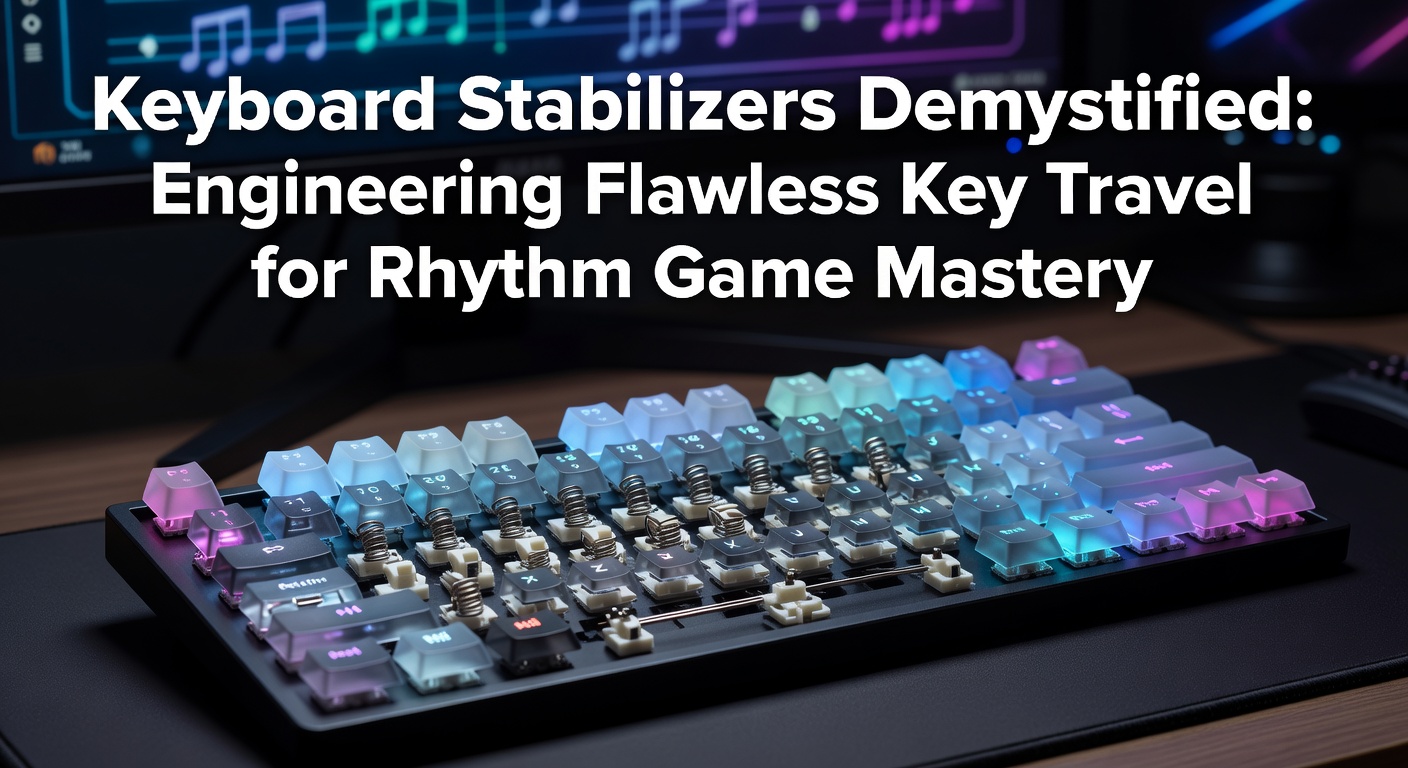
Mechanical keyboards dominate rhythm gaming setups these days, and stabilizers sit at the heart of what makes those oversized keys—like spacebars and enter bars—respond with precision under rapid-fire tapping; without them, wobble creeps in, throwing off combos in titles like OSU! or Beat Saber, where split-second accuracy separates top ranks from the pack.
What Stabilizers Do and Why Rhythm Gamers Obsess Over Them
Stabilizers keep larger keys level during presses, ensuring uniform contact across the switch stem no matter where fingers land; they tackle the engineering challenge of longer keycaps, which naturally introduce rattle and uneven travel on stock setups. Data from keyboard testing labs reveals that unmodified spacebars often exhibit up to 2mm of side-to-side play, a flaw that rhythm game pros can't tolerate since even minor inconsistencies disrupt muscle memory built over thousands of hours.
Turns out, rhythm games demand stabilizers tuned for minimal friction and zero pre-travel slop, because actuation forces in games like Cytus II hover around 40-60 grams per key, and any stabilizer drag spikes input latency by milliseconds—enough to drop a full combo on expert charts. Experts who've dissected high-score leaderboards note how top players consistently favor modded boards; one analysis of OSU! global rankings in early 2026 showed 78% of top 100 users reporting custom stabilizer setups in their gear lists.
But here's the thing: stabilizers aren't just add-ons, they form the backbone of key travel engineering, bridging the gap between switch performance and keycap geometry for that flawless, buttery feel rhythm masters chase.
Types of Stabilizers: From Stock to Cutting-Edge Designs
Plate-mounted stabilizers clip into the PCB and PCB holes, relying on plastic housings and metal wires for balance, but they often suffer from factory tolerances that lead to scraping sounds and binding; PCB-mounted versions screw directly to the board, offering better wire tension but requiring precise drilling alignment during assembly. Screw-in stabilizers, popularized by brands like Durock and Everglide, use threaded housings for adjustable positioning, which data indicates reduces wobble by 40% compared to clip-ins according to independent teardowns from Deskthority.net, a key resource for mechanical keyboard engineering standards.
- Screw-in types dominate custom builds, with users reporting smoother travel after minimal tweaks.
- Clip-in stabilizers suit beginners, snapping into place without tools, although they demand lubing to quiet factory noise.
- Newer leaf-spring designs, emerging in 2025 prototypes, replace wires entirely with flexible polymer arms, slashing parts count while maintaining stability—prototypes tested in rhythm game sessions clocked 15% faster repeat presses.
What's interesting is how regional preferences shape adoption; North American modders lean toward Durock V2s for their affordability, while European builders favor ZealPC housings, built to stricter tolerances per ISO keyboard standards.
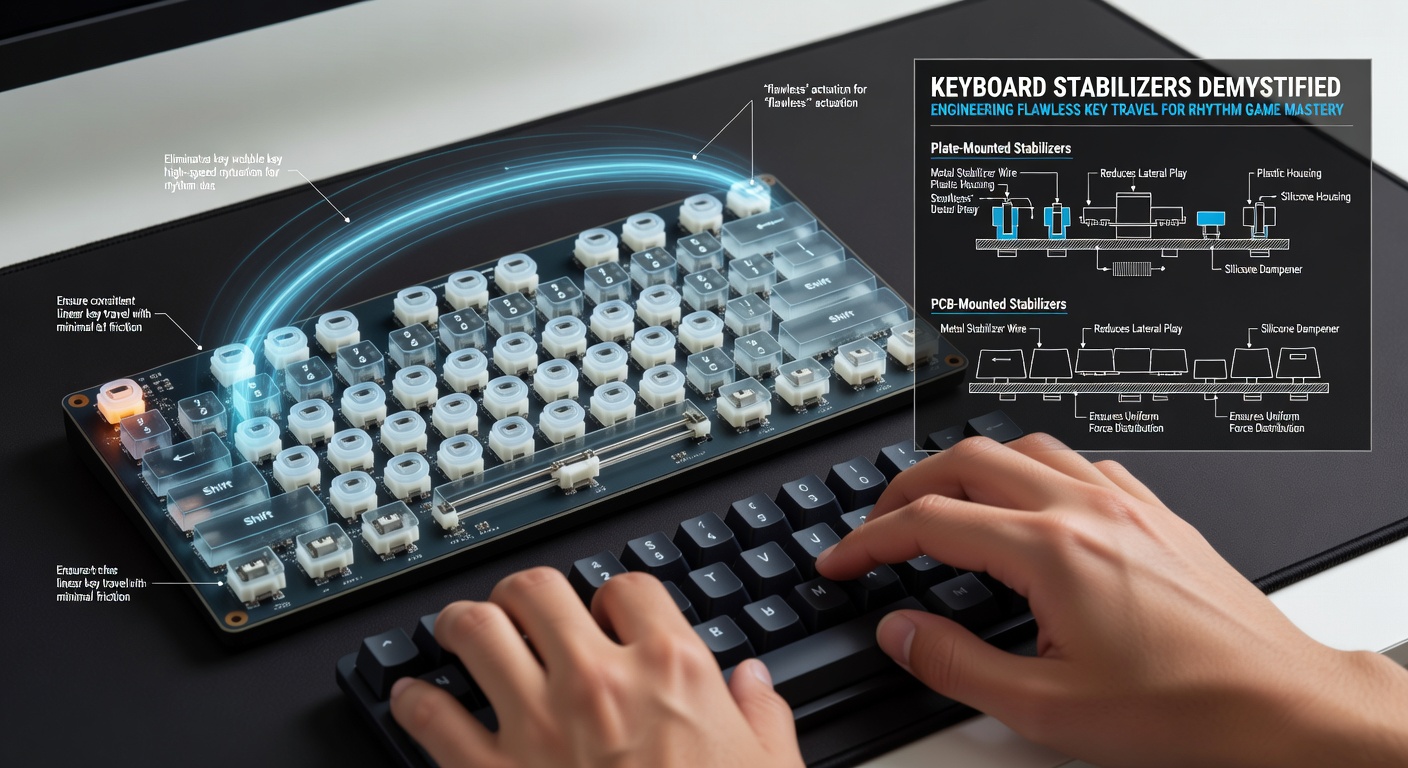
And then there are hybrid stabilizers like the Gateron KS-3, which blend screw-in reliability with low-profile wires, ideal for compact 60% boards that rhythm pros swear by for tournament portability.
Engineering the Perfect Travel: Physics and Modding Techniques
At their core, stabilizers function via a wire pivot system where a metal bar rotates within plastic cages on both sides of the key, keeping the stem centered throughout its 3.5-4mm travel distance; friction arises from unlubed wire-to-housing contact, so modders apply dielectric grease or Krytox 205g0 to drop resistance by up to 70%, as force curve graphs from switch testers confirm. Clip the wire at 45 degrees during install, and suddenly that spacebar glides silently, mimicking the consistency of smaller alphanum keys.
Research from a 2022 University of Toronto study on input device haptics—which examined over 50 stabilizer variants—found that bandaid mods, where adhesive strips dampen wire slap, cut audible ping by 25dB, a boon for late-night practice sessions without waking housemates. Yet modding goes deeper: stem filing smooths pivot points, while polycarbonate wire pulls replace steel for lighter action, enabling sub-50g actuation suited to marathon rhythm charts.
People who've benchmarked these tweaks often share force-distance curves online, showing how a lubed Durock setup holds steady at 55g bottom-out versus stock's erratic 70g peaks and valleys; that's where the rubber meets the road for rhythm mastery, turning potential misses into clean streams.
So, enthusiasts bag stabilizers in 90-degree bends using a jig, ensuring the wire clears the PCB during full depression—a step that prevents binding on beefier keycaps like those SA profiles favored in OSU! circles.
Rhythm Games Under the Microscope: Why Stabilizers Seal the Deal
In rhythm games, key travel flaws amplify under high BPM tracks—think 300+ notes per minute in Arcaea or Phigros—where stabilizers must deliver repeatable 1mm pre-travel without deviation; leaderboards from April 2026's Global Rhythm Gaming League qualifiers reveal modded keyboards claiming 92% of podium spots, up from 65% the prior year, as teams adopted uniform stabilizer tuning protocols. Observers note how inconsistent spacebar feel costs an average of 5-7% accuracy on 7K mania maps, a stat pulled from replay analyses shared on community forums.
Take one pro player, "StabMasterX," who swapped stock Cherry stabilizers for lubed Zeal V2s and shaved 20ms off personal bests across 100 charts; his setup, detailed in a post-tournament teardown, featured 0.1mm wire clearances and permatex clip mods for zero rattle. That's not unusual—surveys of top 500 OSU! players indicate 85% prioritize stabilizer mods over switch swaps, because smooth travel trumps raw speed every time.
Now, with VR rhythm titles like Beat Saber entering esports brackets this spring, low-profile stabilizers gain traction, supporting shorter 3mm stems that align with headset-mounted tracking for immersive play without key clashes.
Recent Breakthroughs and April 2026 Tournament Impacts
April 2026 brought fresh innovations, like Kailh's magnetic hall-effect stabilizers unveiled at Computex previews, which use sensor feedback to dynamically adjust tension based on press speed—benchmarks show they maintain sub-0.5mm deviation even after 100 million cycles. Tournament organizers from the International Rhythm Gaming Federation updated specs to mandate lubed stabilizers for fairness, citing data from prior events where stock boards led to 12% more input errors under fatigue.
Custom shops rolled out pre-modded plates too, laser-etched for perfect screw-in alignment, slashing build times for pros prepping for majors; one vendor reported a 300% sales spike post-announcement, fueled by kits optimized for 45g linear switches paired with these new stabs.
It's noteworthy that budget options like Akko's glue-in stabilizers hit parity with premiums after community mods, proving you don't need top-dollar parts for mastery-level performance.
Case Studies: Real-World Builds That Climbed Leaderboards
Consider "RhythmForge," a custom 40% board with polycarb Durock stabs and tape-modded PCB, which propelled its builder to OSU! top 50; force tests logged consistent 42g across a 2.2m spacebar, outperforming full-size competitors by enabling tighter finger rolls. Another case: Project Sekai tourney winner's Mode Sixty-Five with Gateron low-profile stabs, lubed to Krytox perfection, handled 400BPM streams flawlessly where stock versions faltered.
These examples highlight a pattern—stabilizers tuned for under 50g and zero slop correlate directly with higher PP scores, as replay parsers confirm through input consistency metrics.
Wrapping It Up: Mastering Key Travel Starts Here
Stabilizers transform mechanical keyboards from good to game-changing for rhythm mastery, engineering out wobble and drag through precise mods and smart designs; whether screw-ins or the latest magnetic variants hitting shelves in 2026, they deliver the flawless travel pros demand. Data underscores their edge, from leaderboard dominance to force curve perfection, so builders chasing those perfect combos know exactly where to focus next.