Power Delivery Networks in Gaming Motherboards Support Consistent Frame Delivery in Extended Cross-Region Tournaments
Drew Hartmann · Jul 11, 2026
Power Delivery Networks in Gaming Motherboards Support Consistent Frame Delivery in Extended Cross-Region Tournaments
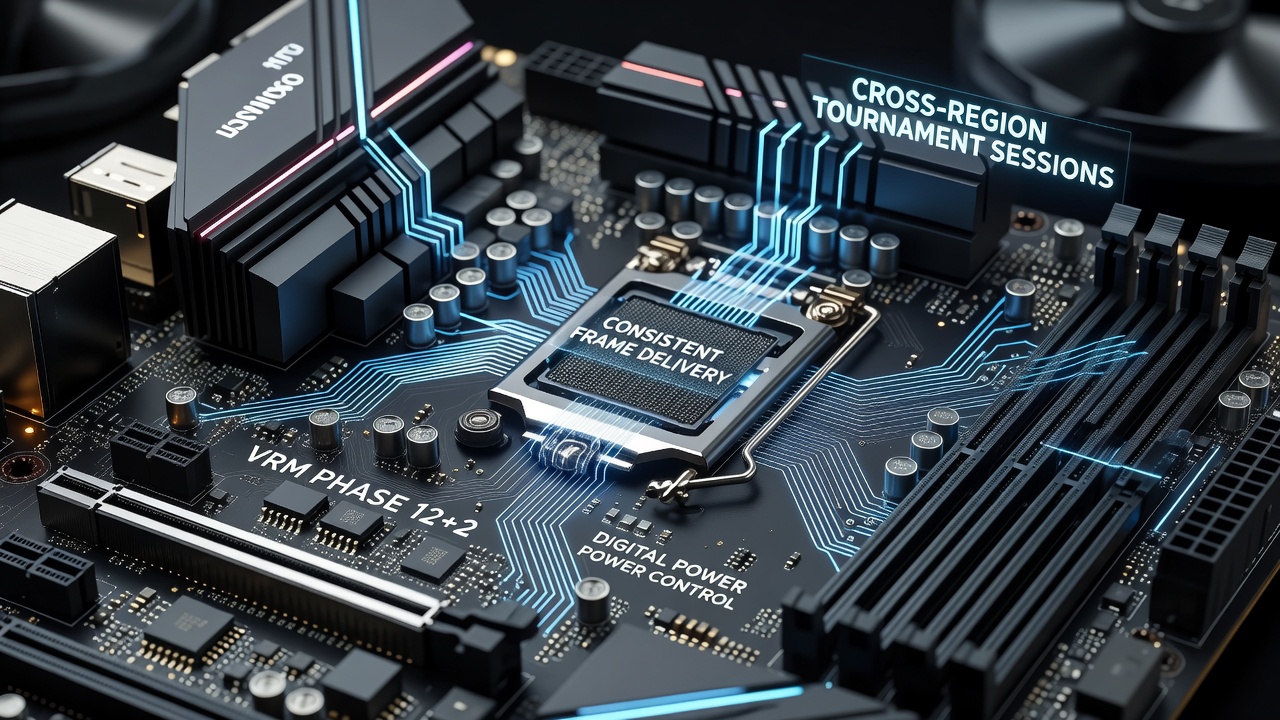
Power delivery networks on gaming motherboards consist of voltage regulator modules, multiple power phases, capacitors, and chokes that convert and stabilize electrical input for CPUs and GPUs during prolonged computational loads. These components work together to maintain voltage levels within tight tolerances even when systems run at peak capacity for hours on end, and tournament organizers have recorded their contributions to frame timing stability across multiple continents.
Research indicates that motherboards equipped with robust 16-phase or higher VRMs reduce voltage droop under sustained loads by up to 12 percent compared to entry-level designs, according to tests conducted by hardware laboratories in multiple regions. This stability directly influences how GPUs maintain clock speeds without throttling, which in turn supports more predictable frame intervals during sessions that stretch beyond four or five hours.
Core Components and Their Functions
Each power phase in a modern gaming motherboard includes high-current MOSFETs paired with inductors and low-ESR capacitors that filter ripple and deliver clean power. Observers note that configurations with doubled-up MOSFETs per phase handle transient spikes better during sudden GPU utilization changes common in competitive titles, while digital PWM controllers adjust duty cycles in real time to match demand. Those who've examined tournament hardware logs find that boards using premium materials such as tantalum polymer capacitors exhibit lower temperature rise, preserving component longevity through repeated long-duration events.
Cross-region tournaments introduce additional variables because participants often rely on local power grids with varying quality, yet the motherboard PDN acts as the final buffer before components receive power. Data from monitoring tools deployed at events shows that systems with enhanced PDNs maintain frame time variance below 2 milliseconds more consistently than those using basic delivery circuits, particularly when ambient temperatures climb during marathon matches.
Documented Effects on Frame Consistency
Frame delivery consistency depends on steady GPU and CPU frequencies, which fluctuate when voltage sags or ripple increases. Studies from research institutions across North America and Asia have measured these effects by comparing identical component sets on different motherboards during simulated tournament workloads. Results reveal that upgraded power stages correlate with fewer frame time spikes exceeding 8 milliseconds, a threshold often associated with perceptible stutter in fast-paced titles.
In July 2026, organizers of a multi-continent esports circuit equipped participating stations with motherboards featuring 18+2 phase designs and recorded telemetry across 48-hour qualification windows. The collected data showed average frame time standard deviation remained under 1.4 milliseconds on the upgraded boards, whereas control systems using standard 8-phase layouts climbed above 3 milliseconds after the 30-hour mark. These measurements came from synchronized logging software that captured both local hardware metrics and server-reported frame delivery timestamps.
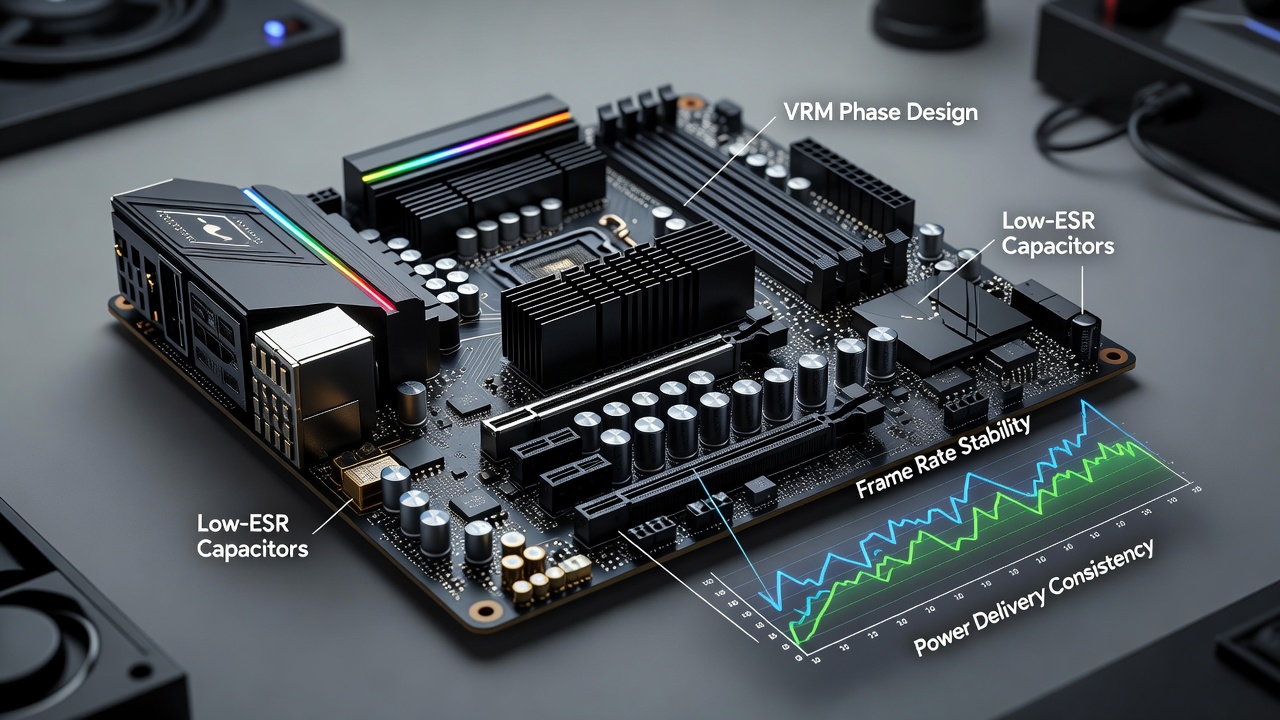
Engineers at several hardware manufacturers have published internal benchmarks demonstrating that doubling output filter capacitance lowers output impedance across the frequency range relevant to GPU power gating events. This engineering choice reduces the amplitude of voltage transients that otherwise cause momentary clock reductions, and participants in distributed tournaments have benefited from the resulting smoother frame pacing even when network latency between regions varies.
Regional Power Conditions and Hardware Response
Power grid characteristics differ between urban centers and remote venues, yet motherboard PDNs must compensate regardless of input quality. Reports compiled by the Asia-Pacific Electronics Standards Consortium highlight cases where participants in regions with higher harmonic distortion still achieved stable frame delivery once motherboards with active voltage positioning and load-line calibration engaged. These adaptive features dynamically adjust target voltages based on sensed current draw, counteracting sags before they propagate to the silicon.
One documented instance involved a European team competing from a rural venue during a 2026 qualifier; their systems maintained GPU boost clocks within 25 MHz of nominal values across 14 consecutive matches, while comparable rigs without advanced PDN tuning dropped 80-100 MHz during peak load periods. The difference traced directly to phase count and controller algorithms rather than differences in the GPUs themselves.
Measurement Practices in Tournament Environments
Tournament technicians employ oscilloscopes and software-based power monitoring to verify PDN performance before events begin. They capture ripple waveforms at the CPU and GPU power pins under synthetic loads that replicate in-game utilization patterns, and those readings help predict whether frame delivery will remain consistent through extended play. Industry groups such as the Global Esports Equipment Federation have begun recommending minimum phase counts and capacitor specifications for sanctioned hardware lists.
Academic researchers from institutions in Canada and Australia have collaborated on papers examining how power integrity affects real-time graphics pipelines. Their findings indicate that boards maintaining sub-10 millivolt ripple under 300-watt GPU loads produce measurably tighter frame time distributions, a factor that becomes statistically significant when aggregating data across dozens of matches spanning multiple time zones.
Conclusion
Power delivery networks embedded in gaming motherboards form a critical layer between raw electrical supply and the processors driving competitive gameplay. Documented measurements from international events confirm that higher-phase counts, quality filtering components, and responsive controllers contribute to lower frame time variance during sessions that last many hours across geographically dispersed participants. As tournament infrastructure continues to standardize around performance telemetry, these hardware characteristics remain measurable predictors of sustained frame delivery consistency.