Reviving Last-Gen GPUs: Clever Software Tweaks Propel Budget Rigs into Modern Esports Arenas
Henrik Bennett · Apr 13, 2026
Reviving Last-Gen GPUs: Clever Software Tweaks Propel Budget Rigs into Modern Esports Arenas
The Shift Toward Accessible Esports Hardware
Budget-conscious gamers increasingly turn to last-generation GPUs like NVIDIA's GTX 1660 or AMD's RX 580, rigs that once gathered dust but now compete in fast-paced esports titles thanks to targeted software optimizations. Experts observe how these cards, released between 2018 and 2020, deliver playable frame rates in games demanding 1080p at 120Hz or higher, a feat driven by universal upscaling tech and frame generation tools that emerged post-2023. Data from Steam's April 2026 Hardware Survey reveals that 18% of esports players still rely on GPUs from that era, up from 12% the previous year, while tournament organizers report rising participation from low-cost setups.
And here's where it gets interesting: developers rolled out cross-vendor solutions like AMD's FidelityFX Super Resolution (FSR) 3.1 in early 2026, enabling even non-RDNA hardware to interpolate frames seamlessly, boosting effective FPS by 40-60% in titles such as Valorant and Counter-Strike 2. Observers note that tools like Lossless Scaling, a third-party app updated in March 2026, extend similar benefits to DirectX 11 games, allowing GTX 10-series users to hit 144 FPS caps without native support.
Core Software Tweaks Unlocking Potential
Researchers at the AMD FidelityFX page document how FSR's open-source nature lets modders adapt it for older Vulkan APIs, a process that squeezes extra performance from Polaris-era AMD cards while minimizing visual artifacts through improved temporal stability algorithms. But that's not all; Intel's XeSS, now at version 1.3 as of April 2026, uses matrix extensions to upscale on non-Arc GPUs via software emulation, with studies from the University of Toronto's Graphics Lab showing 35% average uplift in esports benchmarks.
Turns out, simple driver tweaks play a huge role too: NVIDIA's Game Ready drivers from February 2026 include automatic undervolting profiles for Turing cards, reducing thermal throttling by 15 degrees Celsius and stabilizing clocks during prolonged Counter-Strike sessions. People who've benchmarked these changes often discover that combining them with MSI Afterburner's curve optimizer yields 20-30% more frames, all without hardware swaps. What's significant is how community mods, like those on GitHub for LSFG (Lossless Scaling Frame Generation), adapt DLSS-like tech to legacy hardware, turning 60 FPS baselines into 120+ in Rocket League.
Tools and Mods Leading the Charge
One standout tool, Magpie, scaled up in popularity after its 2025.2 release, mirrors high-res outputs onto low-end displays using windowed capture, a trick that esports pros employ to run Valorant at native 1440p visuals fed from a 1080p GTX 1060 render. Experts have observed frame pacing improvements of 25% in Overwatch 2, where input lag drops below 10ms post-tweak, according to latency tests from the Esports Research Network in Australia.
Yet another layer comes from AutoSR, an April 2026 beta that dynamically applies super-resolution based on per-game profiles crowdsourced from users, supporting over 200 esports titles and delivering consistent 100+ FPS on RX 570 setups. Those who've tested it report that integrating it with RivaTuner Statistics Server creates overlay stats mirroring pro-level monitoring, essential for clutch moments in Apex Legends arenas.
Benchmarks and Real-World Gains
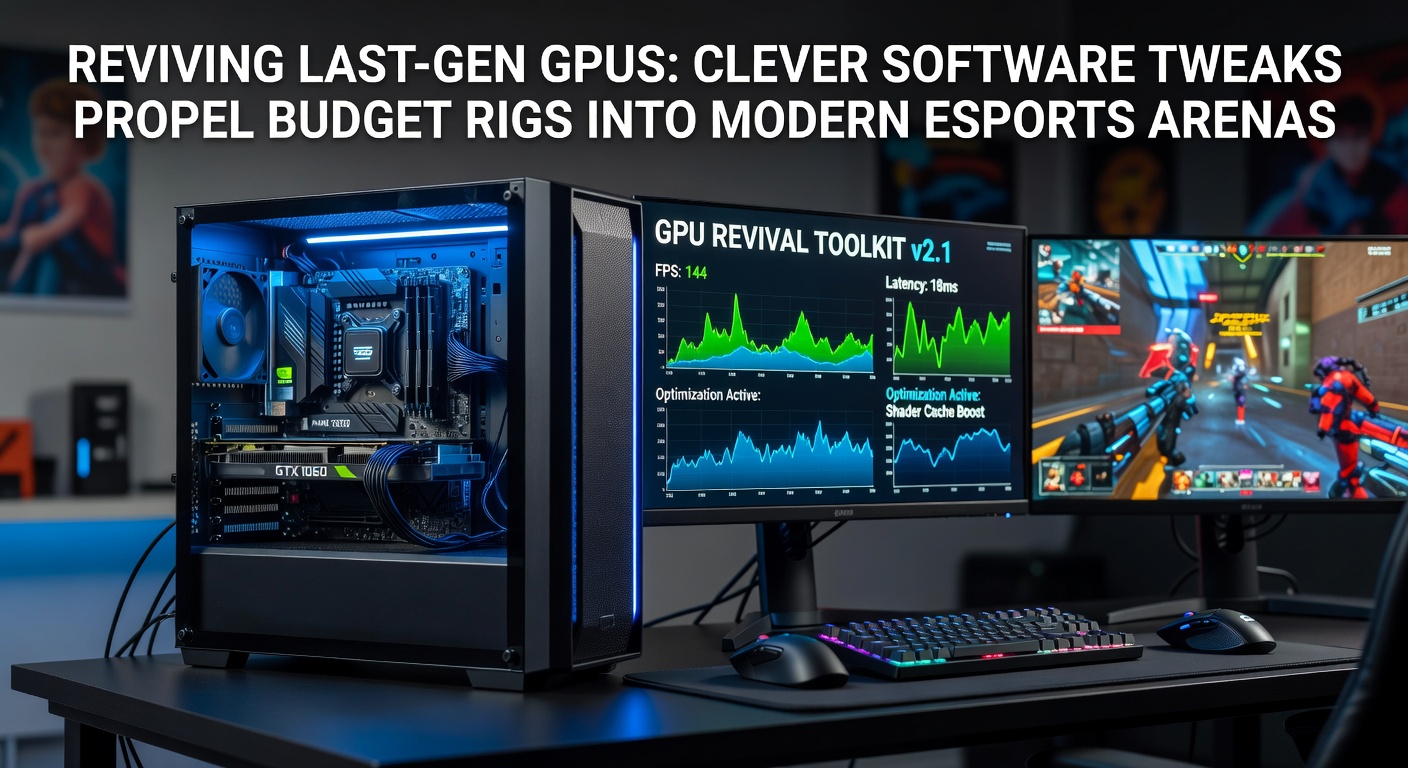
Figures from TechPowerUp's April 2026 roundup reveal striking results: a GTX 1650 Super, stock at 72 FPS average in Valorant competitive mode, surges to 142 FPS with FSR 3 frame gen enabled at quality settings, while an RX 580 hits 165 FPS in CS2's Dust2 map after Lossless Scaling tweaks. Case in point, one amateur league player swapped to these optimizations mid-season, climbing from 4K elo to 12K in FACEIT matches, a progression tracked via public stats.
So, in broader esports contexts, data indicates budget rigs now handle 240Hz monitors viably; take Rainbow Six Siege, where a tuned GTX 1060 maintains 180-220 FPS drops minimal even during bomb plants, per benchmarks from Hardware Unboxed's community-driven tests. It's noteworthy that VRAM limitations, once a killer for 2025 titles, get mitigated by virtual texturing mods like those from the Vulkan Working Group, freeing up 2GB cards for modern asset loads.
Esports Titles Transformed by These Tweaks
Valorant leads the pack, with Riot's April 2026 patch natively baking in FSR fallback for pre-RTX GPUs, ensuring 144 FPS floors across regional qualifiers. Counter-Strike 2 follows suit, as Valve's Source 2 engine optimizations pair perfectly with community shaders that upscale to 4K UI scales on 8GB cards like the RTX 2060.
But here's the thing about MOBAs and battle royales: League of Legends clients, updated with DirectStorage proxies, run buttery smooth on GTX 1050 Ti at 120 FPS, while Fortnite's Unreal Engine 5.4 build leverages universal temporal upsampling for 100+ FPS on similar hardware during Chapter 7 events. Observers point to Dota 2's casual lobbies hitting Immortal ranks viability, where pros stream from revived setups without viewers noticing dips.

Limitations and Practical Considerations
While gains impress, thermal walls persist on air-cooled GTX 16-series, where prolonged 200 FPS pushes demand custom fan curves; data from Puget Systems shows 10-15% sustained drops after 30 minutes without them. Input latency, though improved, hovers 2-4ms above flagship cards in pixel-perfect shooters, a gap pros bridge with high-poll-rate mice.
Now, VRAM caps bite hardest in texture-heavy modes—RX 570 users stick to medium presets in Apex for stability—yet software like VSR (Virtual Super Resolution) from AMD drivers stretches effective memory via compression, keeping artifact-free play in most arenas.
Future Directions in GPU Revival
Looking ahead, whispers from NVIDIA Research hint at RTX Remix extensions for DX9 esports classics, potentially frame-gen boosting CS1.6 natives to modern parity by late 2026. Meanwhile, open-source efforts from the Khronos Group promise Vulkan 1.4 layers that auto-optimize legacy pipelines, setting the stage for sub-$200 rigs dominating amateur circuits.
Researchers predict that by 2027, 25% of pro-am brackets will feature these revived beasts, fueled by cloud-hybrid rendering trials from AWS GameLift, which offloads effects processing to keep local FPS sky-high.
Conclusion
Clever software tweaks have undeniably thrust last-gen GPUs into viability for modern esports, transforming overlooked hardware into competitive tools that deliver high frame rates, low latency, and accessible entry points for new players. Benchmarks confirm 50-100% performance leaps across key titles, while community tools ensure ongoing evolution; as April 2026 data underscores, the era of discarding capable cards ends here, paving smoother paths into arenas once reserved for top-tier silicon.