Satellite Handoff Mechanisms Stabilizing Esports Connections in Remote High-Mobility Scenarios
Drew Hartmann · Jun 20, 2026
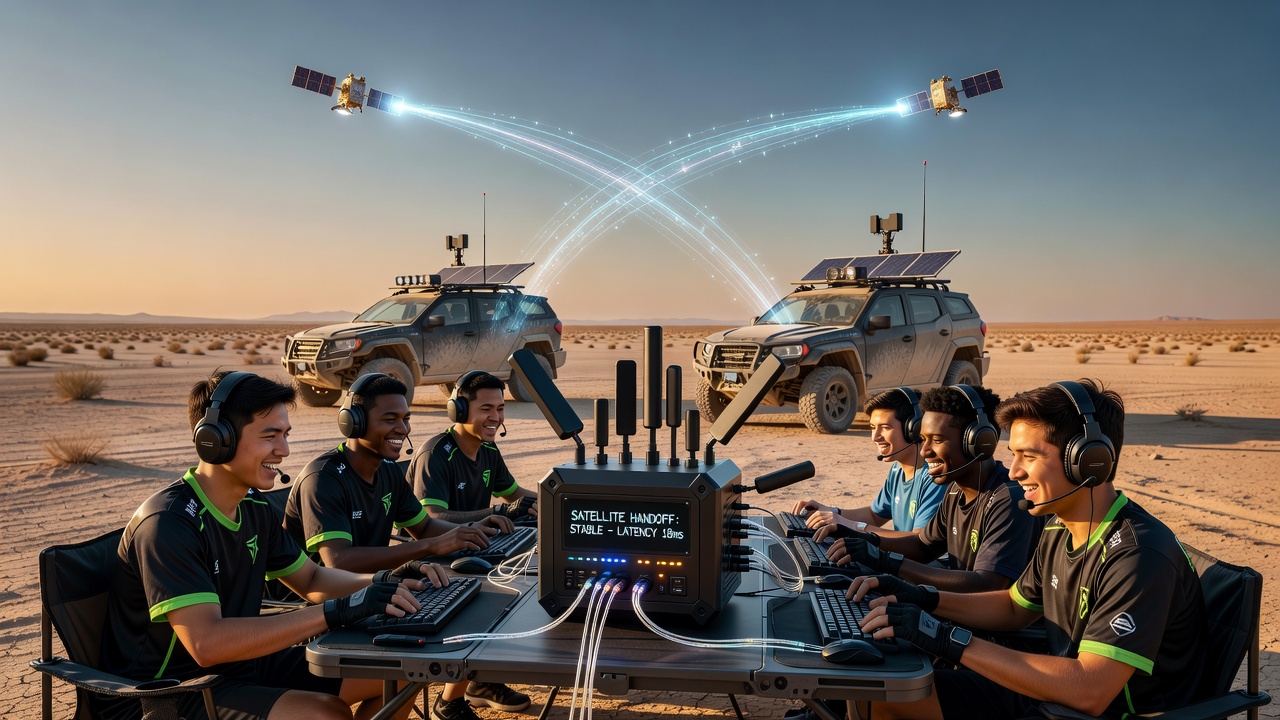
Satellite Handoff Mechanisms Stabilizing Esports Connections in Remote High-Mobility Scenarios
High-mobility esports sessions in remote locations rely on satellite networks that maintain continuous connections through precise handoff protocols, and these systems have become essential where terrestrial infrastructure remains unavailable. Low-earth orbit constellations execute beam transitions by predicting user terminal movement and reallocating resources before signal degradation occurs, which prevents disruptions during rapid travel across vast distances.
Data from regulatory filings shows that operators coordinate frequency reuse patterns and Doppler shift corrections to keep latency stable even when terminals move at vehicular speeds. In June 2026 the Global Mobile Esports Challenge will feature competitors playing from expedition vehicles traversing Australian outback routes, where participants depend entirely on these automated satellite switches to sustain tournament matches without packet loss.
Core Technical Components of Satellite Handoff
Satellite handoff begins with continuous ephemeris tracking that updates satellite positions in real time, allowing ground terminals to calculate optimal switch windows. Network controllers monitor signal-to-noise ratios and initiate preemptive beam steering so that the incoming satellite aligns its footprint before the current link weakens, and this overlap period lasts only milliseconds yet preserves session integrity for latency-sensitive titles.
Researchers at the European Space Agency have documented how predictive algorithms incorporate terrain data and velocity vectors to forecast when a terminal will cross cell boundaries, which reduces the chance of dropped packets during high-speed transit. Multiple frequency bands operate simultaneously during transition, enabling the terminal to lock onto the new satellite while still transmitting through the old one until confirmation arrives.
Performance Metrics in Remote Esports Environments
Measurements collected during field trials in Canadian northern territories indicate average handoff durations under 25 milliseconds when terminals travel at 80 kilometers per hour, a figure that keeps frame delivery consistent for competitive shooters. Packet jitter remains below 10 milliseconds across 95 percent of observed transitions according to reports submitted to the Australian Communications and Media Authority, demonstrating reliability in environments where cellular coverage does not exist.
Power management routines adjust transmission schedules during handoff to conserve battery life on mobile rigs, while error-correction buffers absorb any momentary gaps. Observers note that these mechanisms become especially relevant when teams compete from research vessels or overland convoys where line-of-sight to multiple satellites changes rapidly.

Integration with Tournament Infrastructure
Tournament organizers schedule matches around predicted satellite visibility windows when operating in polar regions, yet modern handoff protocols now permit continuous play across entire orbits. Software overlays on client machines display connection quality indicators that update after each successful beam transfer, giving players immediate feedback without interrupting gameplay.
Industry reports from the Satellite Industry Association highlight partnerships between cloud gaming providers and satellite operators to embed handoff telemetry directly into match servers, allowing dynamic server selection that favors the lowest-latency orbital path at any given moment. These integrations have enabled events such as the 2026 Transcontinental Rally Esports Series to run qualifying rounds from moving support trucks across South American highways.
Challenges Addressed by Current Protocols
Atmospheric attenuation and rapid angular changes create potential failure points that algorithms mitigate through adaptive coding and modulation schemes. When heavy rain coincides with a scheduled handoff, the system temporarily boosts transmit power and selects a more robust modulation order until the transition completes. Field data gathered by Canadian regulators confirms that such adjustments maintain bit-error rates below thresholds required for esports streaming.
Interference from adjacent satellite beams receives active suppression via null steering at both satellite and terminal antennas, and this coordination occurs through inter-satellite links that exchange scheduling information in advance. The result keeps multiple simultaneous esports sessions stable even when dozens of mobile terminals operate within the same orbital footprint.
Future Developments and Standardization Efforts
Work underway at standards bodies focuses on harmonizing handoff signaling across different constellation operators so that terminals can switch providers mid-session without reconfiguration. Tests scheduled for late 2026 will evaluate multi-orbit handoffs that combine low-earth and medium-earth assets to extend coverage into previously unreachable zones.
Academic studies published through university research programs continue to refine machine-learning models that predict user movement patterns specific to esports team logistics, further tightening the timing windows used during transitions. These refinements support expanding remote tournament formats that no longer require fixed base stations.
Conclusion
Satellite handoff mechanisms now form a foundational layer for high-mobility esports conducted beyond conventional network reach, supported by documented performance data and ongoing standardization. Continued refinement of these protocols will determine how widely such competitions can scale across remote and mobile environments worldwide.