Tracing Advancements in Modular Cooling Architectures for Compact Esports Tournament Setups
Frankie Schmitz · Aug 24, 2026
Tracing Advancements in Modular Cooling Architectures for Compact Esports Tournament Setups
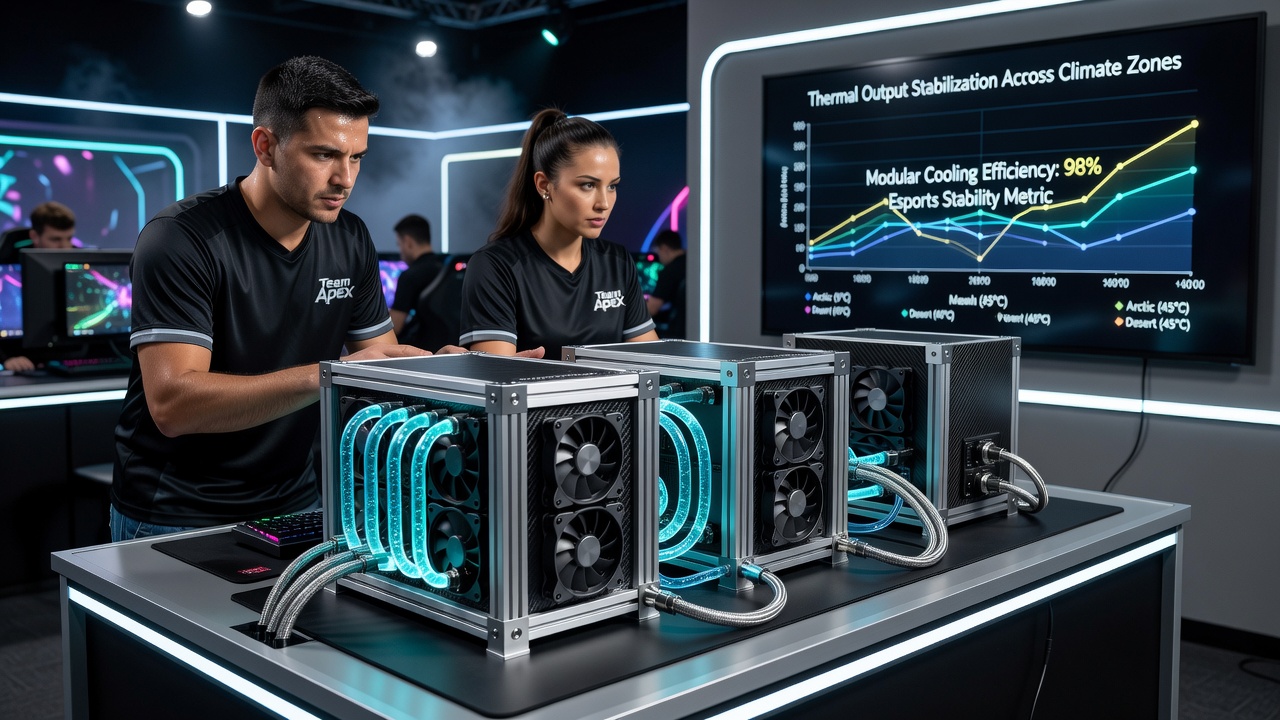
Esports tournaments have shifted toward compact setups that pack high-performance hardware into limited spaces, and these configurations face thermal management challenges that vary sharply by climate zone. In August 2026 several regional events across Southeast Asia and the Middle East tested new modular cooling systems designed to maintain consistent thermal output despite ambient temperatures ranging from 25°C with high humidity to 45°C in arid conditions. Researchers documented how these architectures combine interchangeable cooling modules, such as direct-to-chip liquid loops and phase-change heat sinks, with sensor-driven control units that adjust flow rates in real time.
Core Components of Modular Cooling Systems
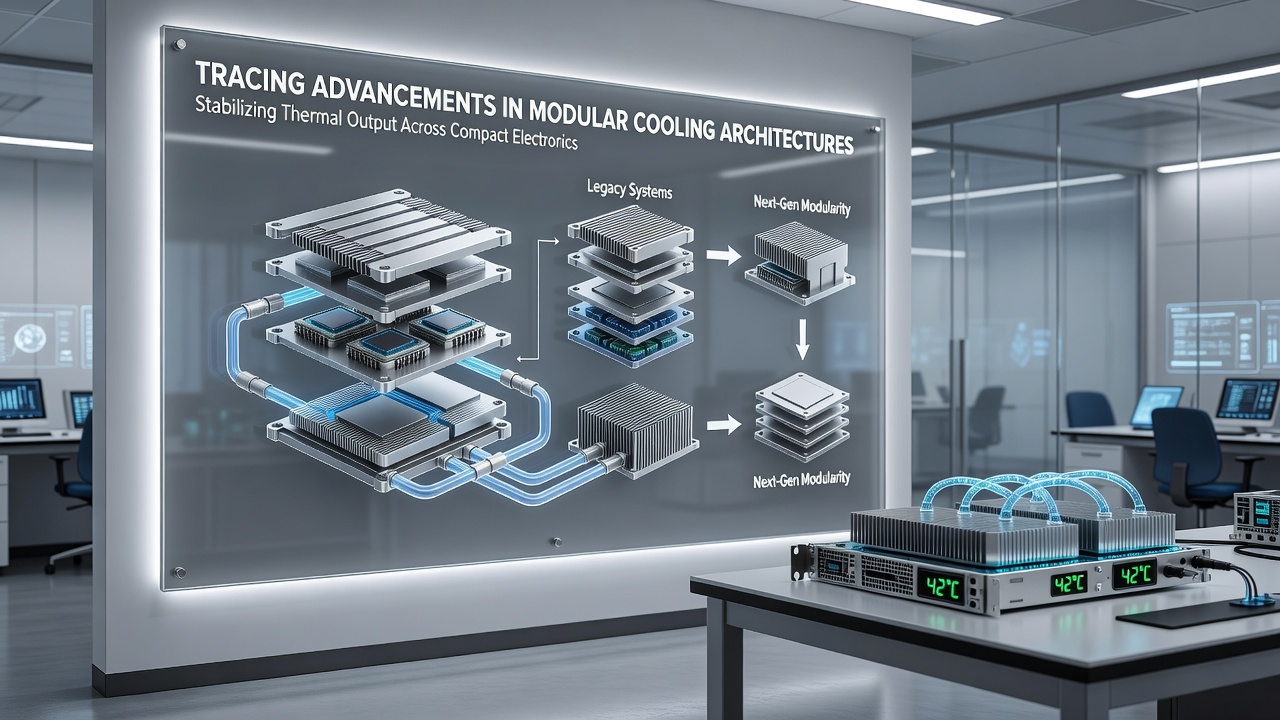
Modular designs rely on standardized interfaces that allow technicians to swap cooling elements without disassembling entire rigs. A typical assembly includes a primary liquid circulation block, auxiliary air fins, and a central controller that monitors die temperatures, coolant pressure, and external humidity. Data from multiple tournament venues show that these systems reduce peak GPU junction temperatures by 12 to 18 degrees Celsius compared with fixed air-cooling configurations under identical loads. The approach draws on principles already applied in data-center rack cooling, yet it has been scaled to fit within 40-liter chassis commonly used at esports events.
Adaptation Across Climate Zones
Variable climate zones introduce distinct variables. Coastal tournaments in humid regions contend with elevated dew points that promote condensation on cold plates, whereas inland desert events deal with dust ingress that clogs heat exchangers. Engineers addressed these differences by incorporating climate-specific modules: hydrophobic coatings on condenser surfaces for tropical venues and electrostatic filters for dusty environments. Field reports from events held in Singapore and Dubai during 2025 and 2026 indicate that swapping the appropriate module reduced unscheduled downtime by 27 percent while keeping frame-time variance below 1.5 milliseconds across hour-long matches.
Performance Data and Standardization Efforts
Industry groups and academic teams have begun publishing benchmark protocols that quantify thermal stability across climate categories. A 2025 study conducted by researchers at the University of Melbourne examined 120 compact tournament rigs operating in both temperate and subtropical conditions; the resulting dataset revealed that modular liquid-air hybrid setups maintained GPU power limits within 3 percent of target values even when external temperatures fluctuated by 15 degrees over a single day. Similar work by the U.S. Department of Energy’s Advanced Manufacturing Office has focused on energy efficiency, reporting that optimized coolant pump curves lowered overall system power draw by 9 percent without compromising thermal headroom.
Standardization bodies such as ASHRAE have released updated guidelines for high-density electronics in non-conditioned spaces, and several esports organizers now reference these documents when specifying equipment for multi-region tours. The guidelines emphasize quick-connect fittings rated for repeated assembly cycles and coolant formulations with low global-warming potential, both of which have seen rapid adoption since mid-2025.
Integration with Tournament Logistics
Compact setups must travel between venues, so cooling architectures incorporate quick-release manifolds and self-sealing quick-disconnect valves that minimize fluid loss during transport. Tournament staff in August 2026 events reported that full module swaps could be completed in under eight minutes, allowing teams to adapt hardware between morning qualifiers and evening finals held in air-conditioned arenas versus open-air stages. This logistical flexibility has proven especially valuable for circuits that span multiple Köppen climate classifications within a single season.
Future Development Pathways
Ongoing work centers on embedding machine-learning models into the central controllers so that predictive algorithms anticipate load spikes from specific game titles and pre-adjust coolant flow before temperature excursions occur. Early prototypes tested at European LAN centers achieved a 4 percent further reduction in thermal variance compared with reactive control loops. Parallel efforts examine nanostructured thermal interface materials that improve heat transfer coefficients by up to 30 percent, potentially allowing even smaller module footprints.
Conclusion
Modular cooling architectures have moved from experimental status to operational deployment across diverse climate zones, supported by measured performance gains and evolving standardization. Continued refinement of interchangeable components, climate-specific adaptations, and integrated control systems positions these designs to meet the thermal demands of increasingly compact esports hardware while maintaining stability regardless of venue location.