Tracing Data Flow Patterns in Hybrid Cloud Architectures Supporting Seamless Cross-Region Esports Events
Parker Schwarz · Aug 8, 2026
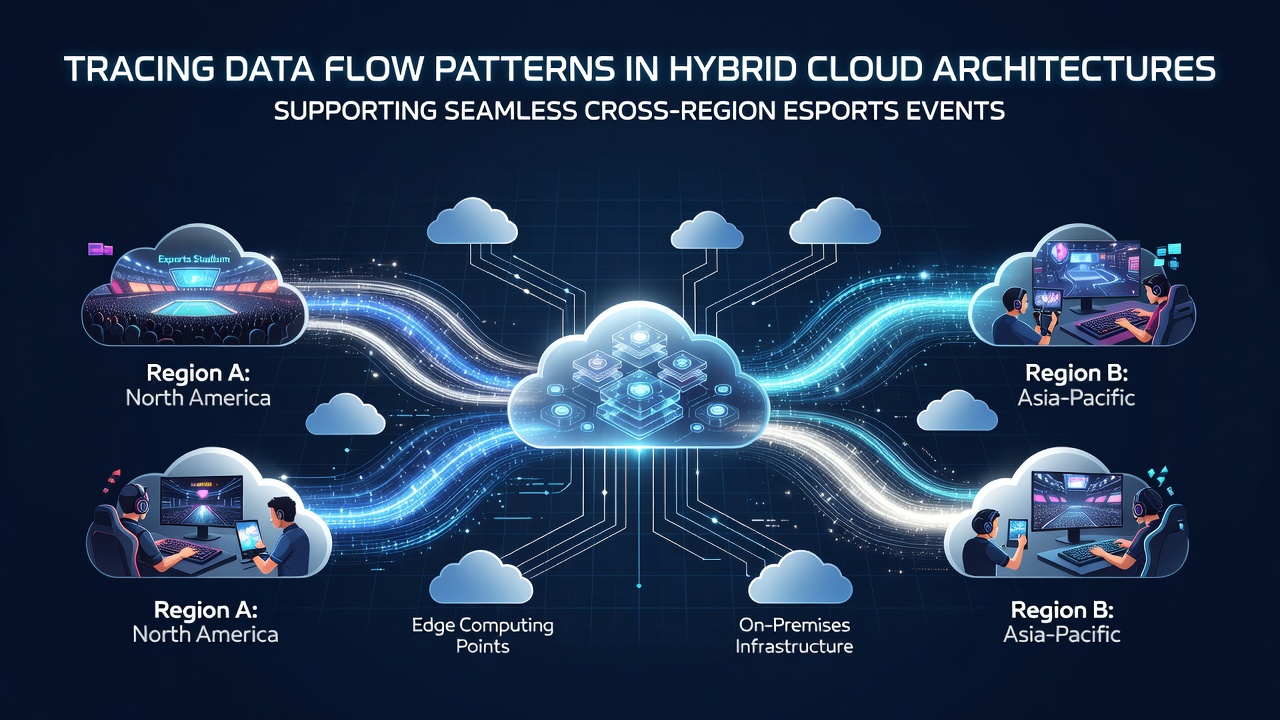
Tracing Data Flow Patterns in Hybrid Cloud Architectures Supporting Seamless Cross-Region Esports Events
Hybrid cloud architectures combine private infrastructure with public cloud resources to manage the intense data demands of cross-region esports events, where players compete from multiple continents in real time. Data flows through these systems begin at edge collection points, move into centralized processing layers, and return to participants with minimal disruption, according to industry reports on distributed gaming networks. Observers note that such patterns rely on synchronized replication protocols that maintain state consistency even when network conditions vary between regions.
Core Components of Data Movement in Hybrid Setups
Private data centers handle sensitive player authentication and session management while public clouds scale compute resources for game simulation and rendering tasks, and this division allows operators to route high-volume telemetry streams through optimized paths. Data packets carrying input commands travel from client devices to the nearest edge node, then traverse interconnects that link private and public segments, whereas analytics workloads shift dynamically based on load thresholds detected by monitoring agents. Researchers have documented these movements using tools that capture timestamps at each hop, revealing bottlenecks in packet serialization during peak tournament hours.
Tracing mechanisms integrate with service meshes that label flows by priority, so latency-sensitive traffic such as position updates receives dedicated queues while background logs route through lower-cost storage tiers. In August 2026, several major esports circuits implemented enhanced tracing layers ahead of intercontinental qualifiers, and figures from those deployments showed average end-to-end latencies reduced by routing decisions informed by real-time flow maps.
Cross-Region Synchronization Techniques
Seamless events require data consistency across geographic boundaries, which hybrid architectures achieve through eventual consistency models combined with conflict-resolution algorithms that reconcile divergent game states. Public cloud regions exchange delta updates via dedicated peering links, while private infrastructure maintains authoritative copies of match rules and scoring logic, and this setup prevents desynchronization when one region experiences transient outages. Studies from distributed systems groups indicate that pattern analysis of these exchanges helps predict congestion points before they affect gameplay.
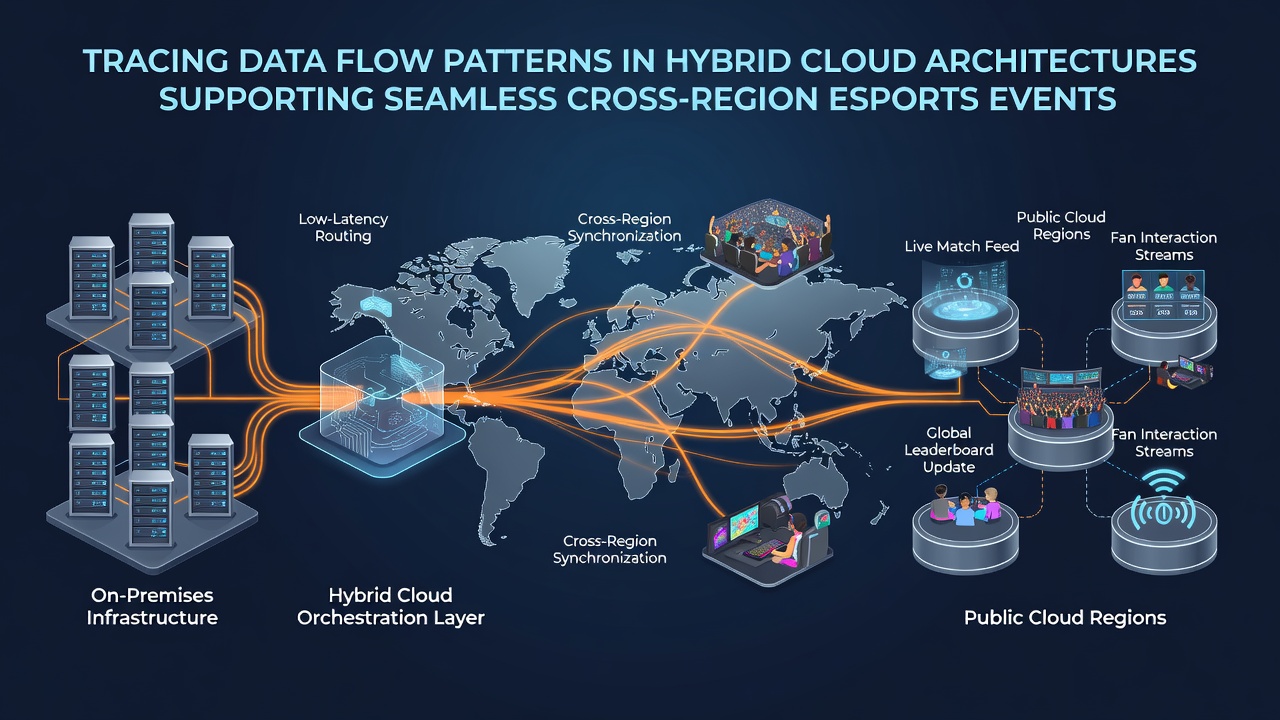
Tracing data flow patterns involves deploying agents that sample traffic at virtual network interfaces and correlate logs across boundaries using unique flow identifiers, and such correlation exposes how multicast groups distribute spectator feeds without overloading core links. Those who've examined production traces note that hybrid setups often employ compression at the edge to shrink payload sizes before they enter public transit paths, which preserves bandwidth for critical player interactions. Data indicates that these optimizations become especially relevant when events span time zones with differing peak usage periods.
Monitoring and Optimization Practices
Operators apply distributed tracing frameworks to visualize complete request paths from client to simulation engine and back, allowing identification of redundant hops that inflate response times. Hybrid environments benefit from unified dashboards that merge metrics from private orchestration platforms and public auto-scaling groups, and this integration supports automated rerouting when flow analysis detects anomalies in packet loss rates. According to documentation from the Cloud Native Computing Foundation, standardized tracing formats enable interoperability between tools deployed across different cloud providers.
Additional patterns emerge when storage layers participate in the flow, as replay buffers and highlight clips move asynchronously to object repositories after matches conclude, freeing primary paths for ongoing sessions. Cross-region esports events in 2026 demonstrated that proactive flow tracing reduced incident response times by surfacing early indicators of regional imbalance before players reported issues.
Conclusion
Tracing data flow patterns within hybrid cloud architectures provides the visibility needed to sustain seamless cross-region esports events through precise routing, synchronization, and monitoring. Patterns documented in operational deployments reveal how private-public handoffs and inter-region exchanges can be tuned to meet the strict timing requirements of competitive play, while ongoing analysis continues to refine these systems for future scale.